Embedded Analytics Cost: A SaaS Team's Budget Guide
A senior engineer costs $135,980+ a year in salary alone (BLS, 2025) — what to actually budget for, whether you buy embedded analytics or build it yourself.
The vendor pricing page says $75 a month. Then the invoice arrives with a data warehouse line item, a contractor bill for the embed integration, and a support ticket queue that needed a part-time hire to keep up. None of those showed up in the sales call. None of them are unusual, either — they're just the parts of embedded analytics that don't fit on a pricing page.
This guide breaks the real cost into the pieces that actually show up on a budget: the platform fee, infrastructure, engineering time to wire it in, and the ongoing cost of keeping it running. It also covers what building the same thing in-house costs, using real salary data instead of a vendor's own comparison chart. That gives you numbers you can defend to a CFO when sizing a build-vs-buy decision.
If you haven't confirmed customers actually need this yet, our guide to knowing when SaaS customers are ready for self-serve analytics is a useful gut-check before you price anything out.
Key Takeaways
- A single senior software engineer costs $135,980 a year in salary alone (U.S. Bureau of Labor Statistics, Occupational Outlook Handbook, May 2025 data) — before benefits, tooling, or the opportunity cost of the roadmap they aren't building instead.
- Embedded analytics platforms typically price by tenant, active user, or a flat tier — the same $2,000/month plan costs $20 per tenant at 100 tenants and $4 per tenant at 500, so the sticker price alone tells you very little.
- 86% of embedded analytics buyers rate self-service as a key purchase factor and 80% rate customizable dashboards as important (insightsoftware and Hanover Research, "Embedded Analytics Insights for 2024," 2024) — both of those are exactly the features vendors gate behind higher tiers.
- The line items missing from most first-pass budgets are infrastructure scaling, SSO/compliance add-ons, and support load — not the subscription fee itself.
What Actually Goes Into an Embedded Analytics Budget?
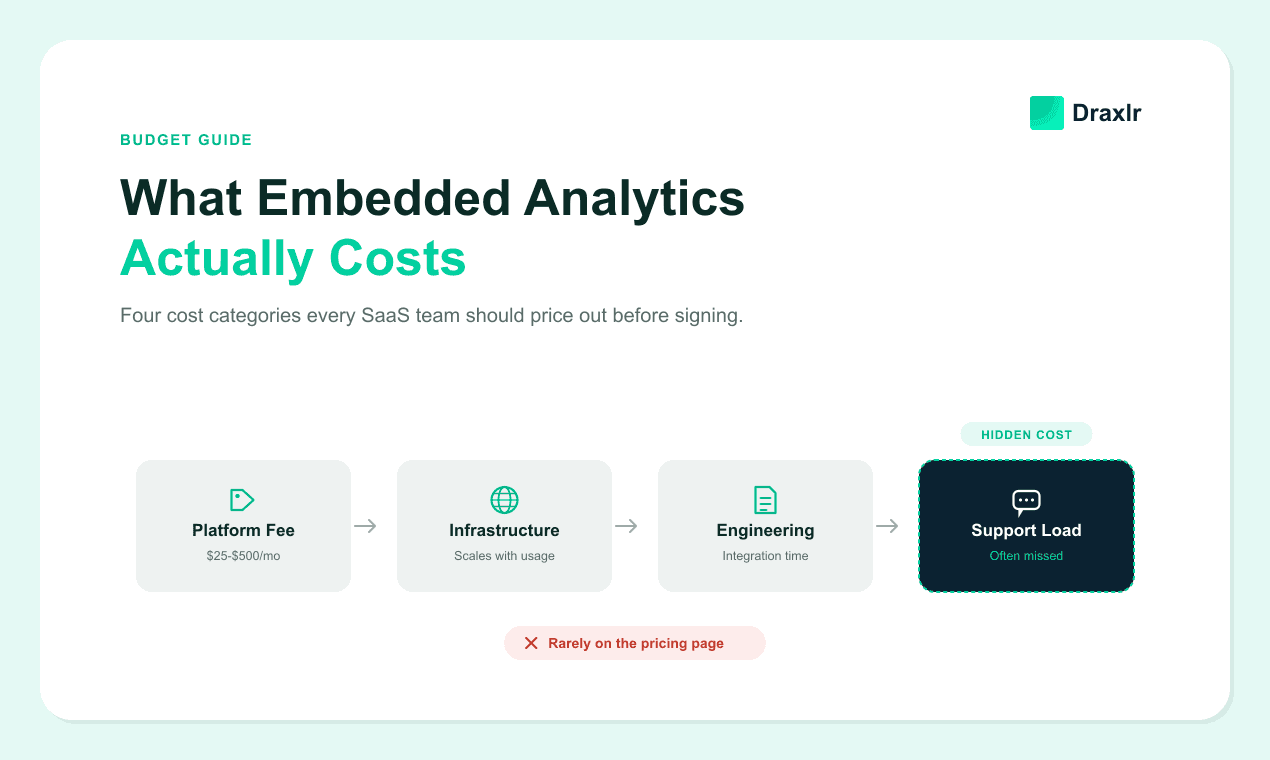
An embedded analytics budget has four real cost categories. There's the platform subscription, the data infrastructure it queries, the engineering time to integrate and maintain it, and the support load it creates once customers start using it. Most teams only price out the first one before signing a contract.
That gap matters because the subscription fee is usually the smallest and most predictable line. Infrastructure scales with data volume and query frequency. Engineering time scales with how deeply the dashboards need to match your product's UI. Support load scales with how many customers actually adopt the feature — and none of these three show up on a vendor's pricing page.
The single biggest budgeting mistake we see isn't underestimating any one category. It's treating the subscription price as the whole answer to "what will this cost," then getting surprised a quarter later when infrastructure and support costs show up as line items nobody planned for.
| Cost category | What drives it | When it shows up |
|---|---|---|
| Platform subscription | Tenant count, active users, or flat tier | Month one, fixed and predictable |
| Data infrastructure | Query volume, data freshness requirements, warehouse or replica costs | Scales with adoption, often invisible until usage grows |
| Engineering integration | Embed depth, tenant isolation setup, SSO, custom theming | Upfront, one-time per major feature |
| Support and maintenance | Customer adoption, dashboard requests, schema changes | Ongoing, grows with your customer base |
How Do Embedded Analytics Vendors Actually Price Their Plans?
Embedded analytics vendors generally price on one of three models: a flat monthly tier with feature gates, a per-tenant or per-active-user fee, or a hybrid of both. Draxlr's own embedding-capable plans start at $75/month, with every embed option and white labeling included and no per-viewer fees, and the $250/month Power plan adds row-level security that scopes each embedded customer to their own rows. What each vendor bundles into that entry price varies widely, which is why embedded analytics pricing is hard to compare on sticker value alone.
The number that matters for your budget isn't the sticker price, it's the price per tenant, because that's the unit your business actually sells against. A $2,000/month plan works out to $20 per tenant at 100 tenants, and drops to $4 per tenant at 500. The same subscription can look expensive or trivial, depending entirely on how many customers you're spreading it across.
Feature gating compounds that math. In 2024, 86% of embedded analytics buyers rated self-service capability as a key purchase factor. 80% said customizable dashboards mattered just as much (insightsoftware and Hanover Research, "Embedded Analytics Insights for 2024," 2024). Those two features are also the ones most commonly locked behind a mid-tier or higher plan. So the entry-level price in a sales deck often isn't the price you'll actually pay once customers ask for what they already expect.
For the architecture behind that "embedded" label, see our explainer on what embedded analytics actually means.
A Simple Per-Tenant Budget Formula
Before comparing vendor quotes, run your own tenant count through this formula: (monthly platform fee ÷ number of active tenants) + (infrastructure cost ÷ number of active tenants) = your real cost per customer. If that number is smaller than what the analytics feature adds to your pricing or retention, the platform pays for itself. If it isn't, either the plan is priced above your current scale or your tenant count needs to grow before the investment makes sense.
What Does Building Embedded Analytics In-House Actually Cost?
The floor for building embedded analytics yourself is one senior engineer's fully loaded time. That floor alone starts at $135,980 a year in salary, before benefits or overhead (U.S. Bureau of Labor Statistics, Occupational Outlook Handbook, Software Developers, May 2025 data). Multi-tenant isolation, an embeddable query layer, and a charting UI realistically need more than one engineer working for more than a few weeks. That number is a starting point, not a ceiling.
In 2025, the Bureau reported the median annual wage for software developers at $135,980, with the top 10% earning more than $214,670. Two engineers spending a single quarter on a first version of embedded dashboards is a conservative estimate — tenant-aware auth, a query API, and a basic front-end all take real time. That one quarter alone can cost as much as years of a mid-tier vendor subscription, before counting the maintenance a build never stops needing.
The build cost that's easiest to underestimate isn't the initial version — it's the maintenance tail. A dashboard feature built in-house doesn't get to skip a sprint when the roadmap gets busy. Every schema change on the product side now has a corresponding update on the analytics side, indefinitely, whether or not anyone budgeted for it.
That maintenance tail is also an opportunity cost, not just a salary line. Every engineer-week spent on tenant isolation or chart rendering is a week not spent on whatever your product actually competes on. For most SaaS teams, analytics isn't the differentiator customers are buying.
Our guide to adding analytics without building a full data platform covers a middle path that avoids most of that opportunity cost. The real question isn't just what the build costs — it's what doesn't get built instead.
What Hidden Costs Do Teams Miss When They Budget for Analytics?
The costs that blow past a first-pass budget are almost never the platform fee. They're the add-ons that only become visible once you're already a customer — SSO, audit logging, dedicated infrastructure, and the support time your team spends once dashboards go live. A vendor's advertised price fits the feature set your first ten customers need, not necessarily your fiftieth or hundredth.
Enterprise-security features are the most common surprise. If even one customer needs single sign-on or an audit trail for their own compliance review, that requirement typically forces an upgrade to the top pricing tier. That jump can run several multiples of the entry price, and a single enterprise deal can trigger it regardless of your overall customer count.
| Hidden cost | What triggers it | How to budget for it |
|---|---|---|
| SSO / audit logs | One enterprise customer's compliance requirement | Ask before you're mid-deal, not after |
| Infrastructure scaling | Query volume growing faster than tenant count | Model cost per query, not just per tenant |
| Support load | Adoption growth once dashboards ship | Track dashboard-related tickets for one quarter pre-launch as a baseline |
| White-labeling / custom domains | Reseller or agency customers wanting their own branding | Confirm which tier includes it before quoting a customer |
For teams that need white-labeling specifically, our guide to white-labeling embedded dashboards without forking the tool covers what that layer costs to build versus buy in more technical detail than fits here.
Setting Your Actual Budget Range
Set your budget range by starting from tenant count and growth rate, not from a vendor's advertised starting price. A plan priced for 500 tenants is a bad deal at 20, and a plan priced for 20 will break down operationally well before you reach 500. Work out your realistic tenant count for the next 12 months first, then price plans against that number specifically.
From there, separate "must-have now" from "will need eventually." Self-service and customizable dashboards matter enough that 86% and 80% of buyers respectively call them key purchase factors (insightsoftware and Hanover Research, 2024). If either is missing from the tier you're pricing, you're likely to re-budget for an upgrade within a year — so it's cheaper to price the tier that includes them from the start.
Finally, ask every vendor the same three questions before comparing quotes. What's excluded from this price that most customers end up adding? What does the next tier up cost? What triggers a forced upgrade? Those three answers tell you more about your real annual cost than the number on the pricing page.
Frequently Asked Questions
What does embedded analytics cost for a small SaaS team?
For a team under 50 tenants, expect to pay in the low hundreds of dollars per month for a mid-tier plan with basic embedding, before infrastructure or engineering integration time. Costs scale with tenant count and feature depth — full white-labeling and SSO both typically require a higher tier than a basic embed.
Is it cheaper to build embedded analytics in-house than to buy it?
Rarely, once engineering time is counted honestly. A single senior engineer costs $135,980 a year in salary alone (BLS, May 2025 data). A working multi-tenant analytics feature usually needs more than one engineer for more than a few weeks, plus ongoing maintenance every time your schema changes.
What's the biggest hidden cost in an embedded analytics budget?
Enterprise security requirements — SSO, audit logs, or dedicated hosting — are the most common trigger for an unplanned tier upgrade. A single enterprise customer's compliance requirement can force it, regardless of your total customer count. Budget for that possibility before it happens in the middle of a deal.
How does per-tenant pricing actually work?
Most embedded analytics vendors charge either a flat monthly fee or a per-active-user rate, and either way the effective cost per customer depends on how many tenants you spread it across. A $2,000/month plan is $20 per tenant at 100 tenants but only $4 per tenant at 500 — always calculate the per-tenant number before comparing vendors.
Conclusion
The platform subscription is the easiest number to find and the least useful one for actually budgeting embedded analytics. Infrastructure, engineering integration, and support load are where most teams end up over or under, and all three scale with adoption rather than staying fixed like a monthly invoice.
Run the per-tenant math against your real growth plan. Price in the features your buyers already tell you they expect — self-service and customizable dashboards chief among them — and ask every vendor what triggers a forced upgrade before you sign. That's a more reliable budget than any number on a pricing page alone.
About the author

Vivek is a coder and the founder of Draxlr who cares deeply about building good products. He works at the intersection of AI, SQL, dashboards, and embedded analytics, with a strong focus on making complex data workflows feel simple, useful, and fast for real teams.
If you have questions about anything in this guide, or want to compare options for your specific stack, you can email Vivek at vivek@draxlr.com, try Draxlr free, or reach out directly through the Draxlr team.