Best Snowflake Reporting Tools
Looking for Snowflake reporting tools? Explore the best options for dashboards, analytics, and internal reporting on your Snowflake data warehouse.

Snowflake gives you a powerful, scalable cloud data warehouse, but getting meaningful reports out of it requires more than running queries in Snowsight. As your data grows and more teams need access to insights, you need dashboards, controlled access, and a repeatable reporting workflow that doesn't rely on developers fielding ad-hoc SQL requests all day.
Engineering and data teams often start by sharing queries or manually exporting results to spreadsheets, only to find that approach breaks down quickly. Dashboards go stale, access control becomes a headache, and every business question ends up in someone's Slack DMs. Building a custom analytics layer on top of Snowflake compounds the problem — it's a significant investment in time and maintenance that rarely stays ahead of the team's actual data needs.
Snowflake reporting tools solve this by connecting directly to your warehouse and providing a clean interface for building dashboards, exploring data, and sharing insights across your organization — without writing infrastructure from scratch. In this article, we break down the most reliable Snowflake reporting tools to consider for 2026.
What are Snowflake reporting tools?
Snowflake reporting tools connect directly to your Snowflake data warehouse and let you build dashboards, charts, and shared reports without writing SQL for every question. They surface live data from Snowflake through a clean interface that both technical and non-technical users can work with — without requiring ETL pipelines, data exports, or a separate analytics database.
Because these tools push queries directly to Snowflake, your data stays in the warehouse where it lives. Permissions remain consistent with your Snowflake configuration, query performance scales with your warehouse compute, and everyone on your team sees the same live numbers. The result is a reporting layer that's accurate, secure, and significantly easier to maintain than anything built in-house.
How to choose a Snowflake reporting tool
Choosing the right Snowflake reporting tool depends on what you're trying to accomplish with your data. A lean product team that needs quick business visibility will have very different requirements from a company looking to embed analytics inside a customer-facing product or consolidate a fragmented BI stack.
Start by identifying your primary goal.
1. If your goal is internal reporting for your team
Pick a tool with strong SQL support, an intuitive dashboard builder, and simple sharing controls. You want something that lets analysts and non-technical stakeholders answer questions independently — without opening a support ticket or pinging the data team.
2. If your goal is customer-facing analytics
Look for embedding, white-label controls, and row-level filtering. Your customers should see analytics that feel native to your product, not a third-party dashboard bolted on.
3. If your goal is replacing an existing analytics stack
Prioritize tools with flexible permissions, reusable query layers, scheduling, and scalable embedding. These features streamline the entire analytics pipeline and reduce the operational overhead of maintaining a reporting stack.
4. If your goal is minimal engineering involvement
Choose a tool that lets product managers, operations teams, or support staff explore data on their own. Visual query builders and AI-powered text-to-SQL dramatically reduce the volume of ad-hoc requests that land in your engineering backlog.
Ultimately, the right Snowflake reporting tool depends on whether you prioritize speed of setup, customer experience, or long-term scalability at the data layer.
Key features to look for in Snowflake reporting tools
Not all Snowflake reporting tools are built the same. Some are designed for enterprise BI workflows with dedicated data teams; others are optimized for fast setup and self-service. Knowing which capabilities matter most for your team makes the decision much easier.
Here are the core features to evaluate when comparing Snowflake reporting tools.
1. Native Snowflake compatibility
Your reporting tool should connect directly to Snowflake without requiring ETL pipelines, data exports, or schema duplication. Native support means:
- Queries execute directly against your Snowflake warehouse
- No syncing or intermediate storage layers
- No new infrastructure to maintain
- Consistent access controls tied to your Snowflake roles
Tools that require you to move or model data before visualizing it will slow you down and add maintenance costs over time.
2. Ease of dashboard building
Most teams using Snowflake aren't running a dedicated BI department, so your reporting tool needs to be accessible. Look for:
- Visual query building
- Text to SQL AI
- Reusable charts and saved queries
- Filters and drill-down support
- Intuitive layout controls
- Simple sharing options
The goal is for anyone on the team to answer common questions without needing developer involvement.
3. Embeddability (if you want customer-facing dashboards)
If you plan to embed analytics inside your product, your reporting tool needs:
- Secure, stateless embed tokens
- Row-level filtering for multi-tenant data models
- White-label styling controls
Dashboards should feel native inside your product — not like a third-party iframe dropped in.
4. API access for automation
Snowflake teams often automate recurring workflows — scheduled reports, data alerts, embedding logic, or export pipelines. An API-first reporting tool gives you:
- Programmatic control over reports and dashboards
- Flexibility to connect with your existing services
- Easier integration with your auth layer
- Automation of recurring tasks without manual effort
5. Data security and access control
Your Snowflake reporting tool must match the security standards your organization already maintains. Key capabilities include:
- No data copying or replication outside the warehouse
- User-scoped and role-based dashboard access
- Secure embedding with token-based isolation
- Strong permission controls at the dashboard and query level
- Self-host option for sensitive environments
Since Snowflake holds your most critical business data, access control is not optional.
6. Documentation, support, and reliability
Reporting is often implemented late in the product cycle — usually under pressure. Solid documentation, responsive support, and a reliable interface save hours when things need to work quickly. Whether through product docs, community Slack, or hands-on onboarding, pick a tool that won't leave your team stuck at a critical moment.
The best Snowflake reporting tools to consider in 2026
Without further delay, here's a breakdown of the top Snowflake reporting tools worth exploring in 2026 and beyond.
1. Draxlr: Best Snowflake reporting tool for dashboards, team insights, and embedded analytics
Best for
SaaS teams and data-driven companies using Snowflake who want a fast, straightforward way to build dashboards, explore warehouse data, and deliver embedded analytics without standing up a complicated BI stack.
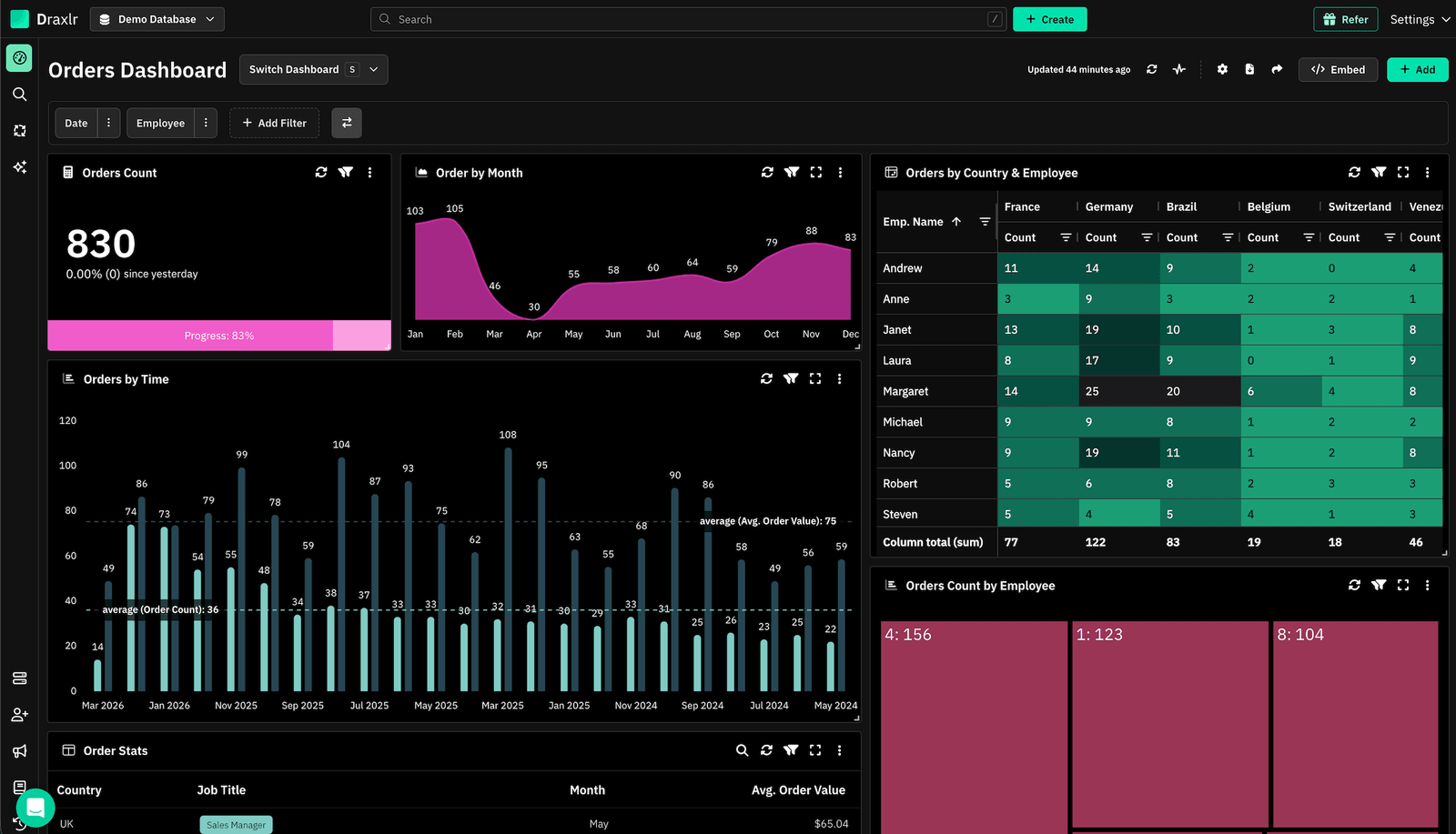
Connect your DatabaseDraxlr connects directly to your Snowflake warehouse and gives teams a clean interface for creating reports, writing SQL, and building dashboards without setup overhead. Built for modern SaaS products, it helps teams ship reporting fast — whether the goal is internal business visibility or customer-facing analytics embedded inside your app.
For technical users, Draxlr offers full SQL control, virtual columns, filters, drill-through features, and database-aware autocomplete. For non-technical teammates, the visual query builder and AI text-to-SQL make data exploration accessible without needing to touch the editor directly.
If your product includes customer analytics, Draxlr supports secure embedded dashboards with row-level filtering, white-label options, and React/Vue components that integrate naturally into your existing product. Teams can also automate reporting with scheduled emails, Slack alerts, and CSV/Excel exports.
Draxlr runs directly against your Snowflake schema — no pipelines, warehouses of warehouses, or additional modeling layers required.
Key features
- Connects directly to Snowflake with no ETL or data movement
- Visual Query Builder, full SQL editor, and AI Chat for text-to-SQL
- Dashboard builder with filters, drill-through, and virtual columns
- Embedded dashboards with secure tokens, row-level filters, and white-label controls
- React and Vue SDKs for easy in-product analytics
- Export options (CSV, Excel, PDF) and scheduled reports
- Team-level permissions for safe, controlled access to production data
- Supports both internal reporting and customer-facing analytics from the same workspace
What users say about Draxlr
Draxlr offers a clean, modern interface and makes it incredibly easy to build dashboards — even for non-technical users. I especially like the visual quality and flexibility of the available graph types. It's intuitive, fast to set up, and has excellent usability from the start. The ability to securely share dashboards via link is a game-changer for our client reporting. — Review from a SaaS Founder on G2
Pricing
Draxlr offers multiple plans depending on team size, embedding needs, and data volume. Pricing starts at $75/month.
2. Sigma Computing: Best for spreadsheet-native Snowflake exploration
Best for
Business teams and analysts who want to explore large Snowflake datasets in a familiar spreadsheet format without writing SQL or waiting on data engineers.
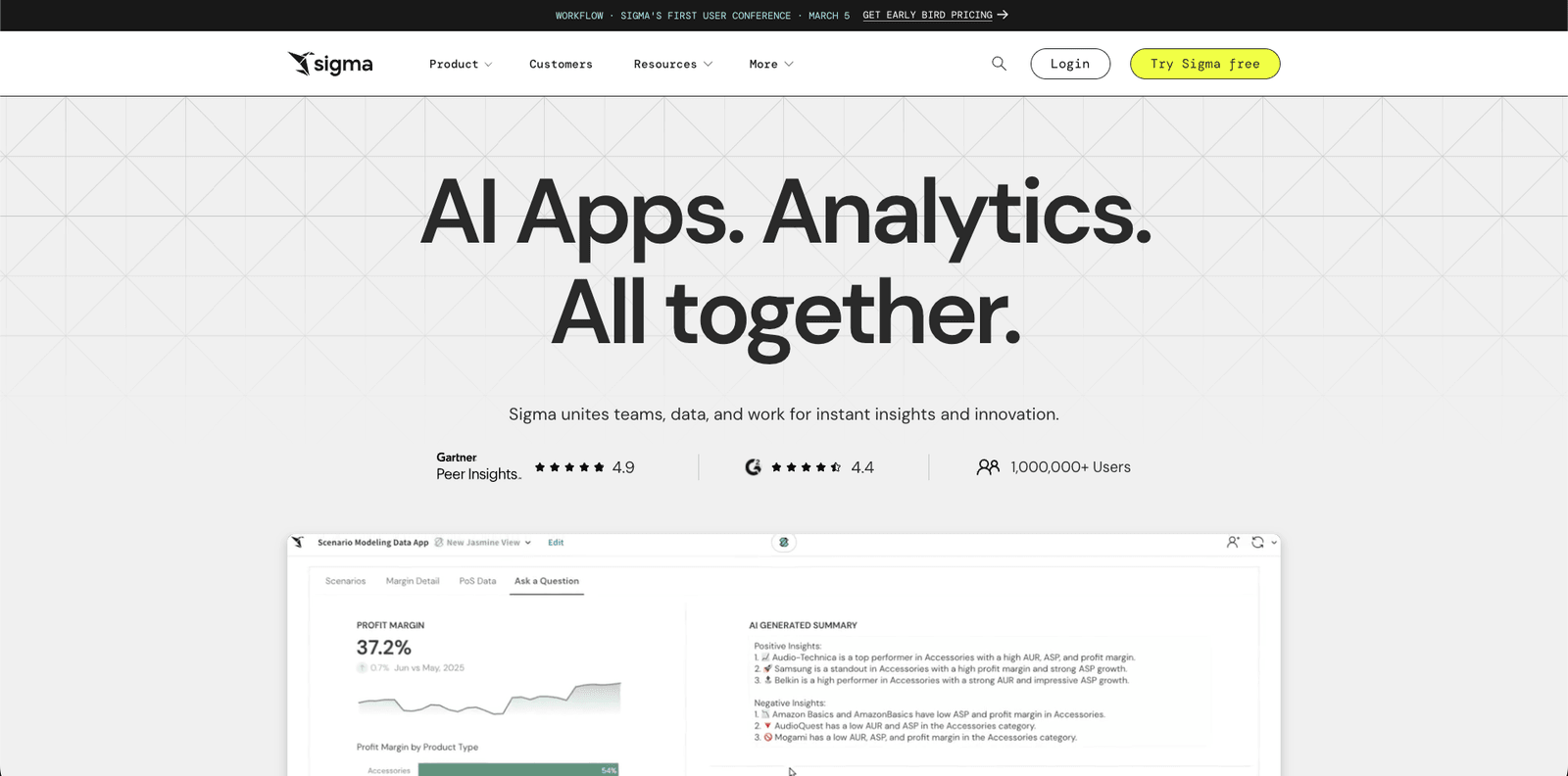
Sigma Computing is purpose-built for cloud data warehouses like Snowflake, pushing all queries directly to the warehouse rather than extracting or caching data. Its distinctive spreadsheet-style interface makes it immediately accessible to business users already fluent in Excel or Google Sheets, allowing them to slice, pivot, and analyze Snowflake data at scale without any SQL knowledge.
Sigma connects to Snowflake using key pair or OAuth authentication and delivers real-time analysis of warehouse data. It supports collaborative dashboards, role-based access controls, and AI-assisted features like formula assistance and visualization explanations. Sigma was named Snowflake's Business Intelligence Data Cloud Product Partner of the Year three consecutive times — a strong indicator of the depth of its Snowflake integration.
For larger organizations with many data consumers, Sigma's pricing model is particularly favorable: it licenses by creators while offering unlimited viewers, making it cost-effective when distribution is wide.
Key features
- Spreadsheet-like interface that requires no SQL knowledge for exploration
- Direct Snowflake connection — no data extraction or caching
- Real-time analysis at warehouse scale with full pushdown compute
- AI tools including Explain Viz and Formula Assistant
- Role-based access control (RBAC) with granular permissions
- Collaborative dashboards and shared workbooks
What users say about Sigma Computing
Sigma is truly built for Snowflake. The ability to work with live warehouse data in a spreadsheet interface — and share it with business users who don't know SQL — has changed how our whole organization engages with data.
Pricing
Sigma Computing plans start at $300/month, with unlimited viewer access available on higher tiers.
3. Tableau: Best for enterprise visual analytics on Snowflake
Best for
Large organizations with dedicated data or analytics teams who need sophisticated visualizations and deep analytical exploration of Snowflake data.
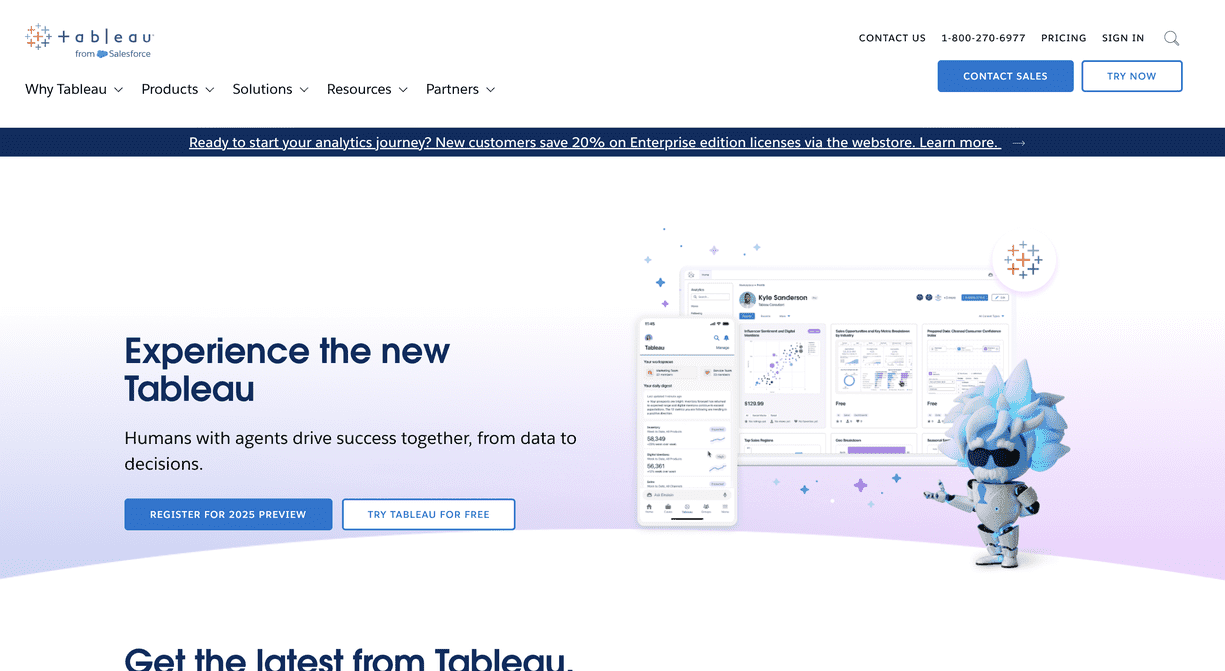
Tableau is one of the most established data visualization platforms in the industry, offering a rich library of chart types, advanced analytical functions, and enterprise-grade governance. It connects to Snowflake via live connection or extract, allowing analysts to build interactive dashboards with complex calculations and storytelling-level visuals.
Tableau's strength lies in its depth — it supports calculated fields, blended data sources, and detailed modeling workflows that enterprise BI teams depend on. However, that depth comes with overhead: Tableau requires more setup and ongoing resources to maintain than lighter-weight tools, making it better suited to teams with dedicated BI capacity than fast-moving product or SaaS teams.
Key features
- Extensive library of chart types and custom visualization options
- Live and extract connection modes to Snowflake
- Tableau Prep for advanced data modeling and cleaning
- Enterprise sharing, governance, and workspace controls
What users say about Tableau
Tableau's design philosophy emphasizes data exploration and visual storytelling over rigid reporting — and the integration with Snowflake is seamless. Large datasets come back fast and the dashboards look polished from day one.
Pricing
Tableau pricing starts at $12 per user/month for Viewer access, with Creator licenses starting at $70 per user/month.
4. Metabase: Best open-source reporting for Snowflake
Best for
Teams that want an accessible, low-cost reporting tool with a clean UI for exploring Snowflake data — especially non-technical teams that need self-service analytics without heavy engineering investment.
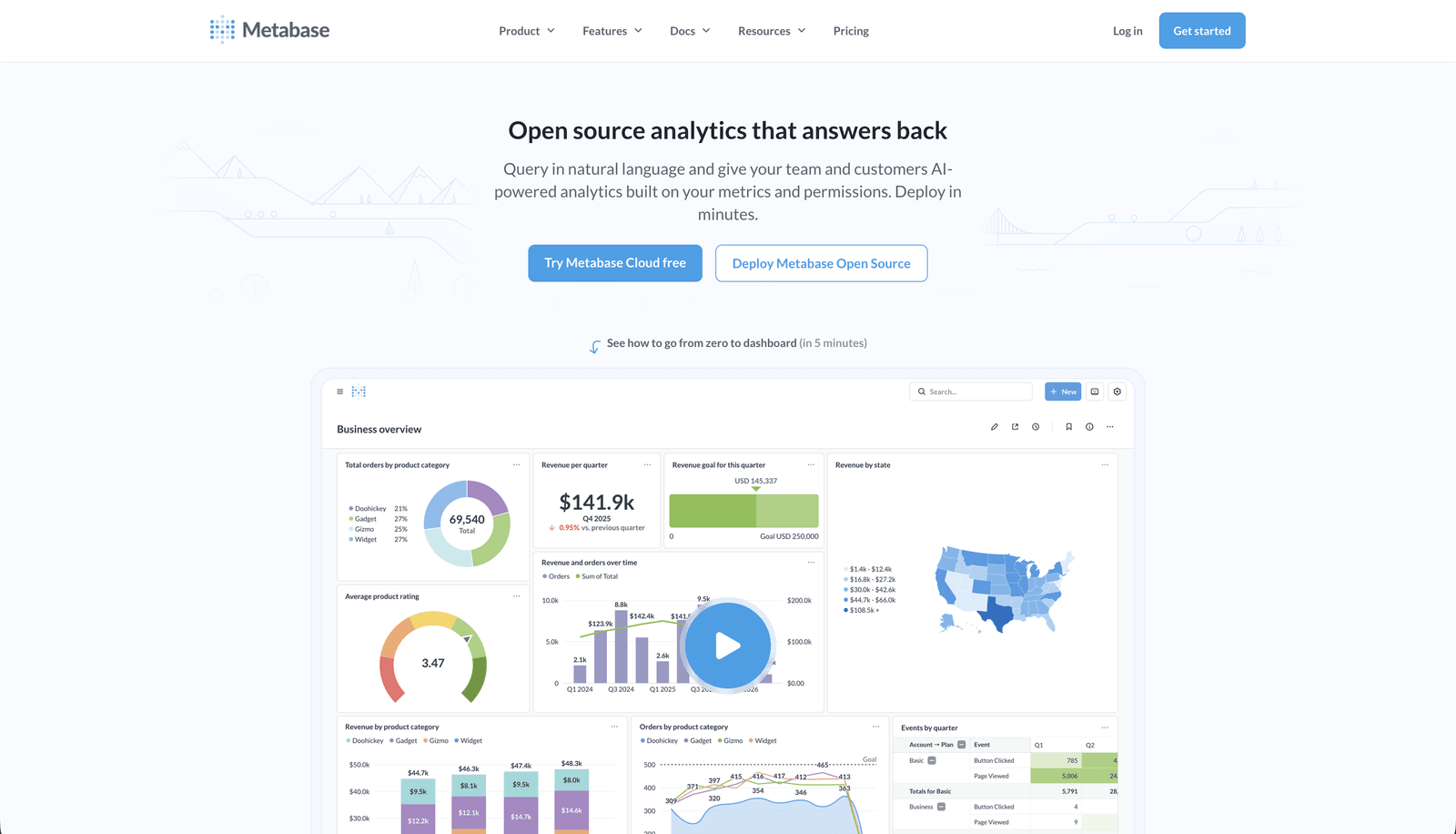
Metabase is a widely used open-source BI platform that connects to Snowflake out of the box. Setup takes around five minutes, after which teams can build questions, dashboards, and scheduled reports without writing any SQL. For users who prefer direct queries, Metabase's SQL editor also provides autocomplete and a preview mode for rapid iteration.
Metabase's approachability is its primary advantage — non-technical users can answer common business questions themselves using the Question Builder, and automated drill-through features are generated automatically on connection. The open-source version is free and can be self-hosted; Metabase Cloud is available for managed hosting. The main trade-off is performance: users have noted slower response times with large Snowflake datasets, and the open-source version has limited embedding and permission features compared to commercial alternatives.
Key features
- Native Snowflake connection with no ETL required
- No-code Question Builder for non-technical users
- SQL editor with autocomplete for technical users
- Scheduled email reports and automated distribution
- Open-source (self-hostable) with a managed Cloud option
What users say about Metabase
Metabase lets our entire team query Snowflake without asking the data team for help. The question builder is genuinely intuitive, and setting up email reports took less than ten minutes.
Pricing
Open-source version is free. Metabase Cloud (managed) starts at $500/month for team plans.
5. Looker Studio: Best free reporting option for Snowflake
Best for
Teams on tight budgets that need a free, browser-based reporting tool with a native Snowflake connector and familiar Google-style UI.
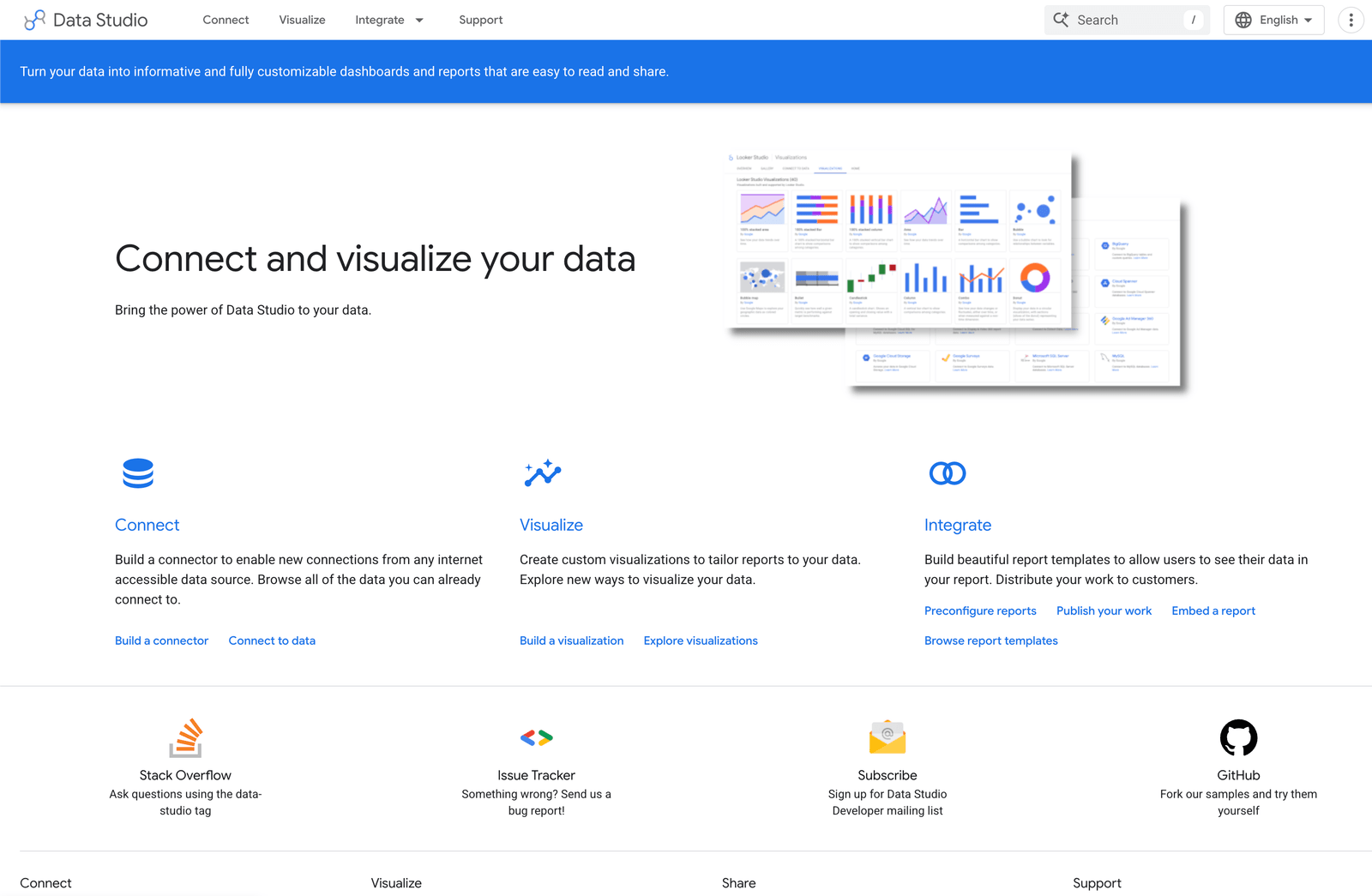
Looker Studio (formerly Google Data Studio) provides a free, web-based reporting interface with a native connector for Snowflake. Users can write SQL queries directly in the connector to pull data into dashboards, then build interactive charts and reports using Looker Studio's drag-and-drop interface. Sharing and scheduling are built in, and reports can be published or embedded without additional cost.
Looker Studio's main advantages are its price point (free), its straightforward sharing model, and its familiarity for teams already using Google Workspace. Its main limitations are a data cap of 1 million rows, restricted customization compared to paid tools, and the need for OAuth or key pair authentication after Snowflake's removal of single-factor auth in late 2025. It's a solid starting point for teams with modest reporting needs, but teams that need embedding, row-level filtering, or more advanced dashboards will quickly find its limits.
Key features
- Free native Snowflake connector with SQL-based data access
- Drag-and-drop dashboard builder with standard chart types
- Built-in sharing, scheduling, and report embedding
- Google Workspace-native — familiar UI for Google-centric teams
- No infrastructure required — fully browser-based
What users say about Looker Studio
Looker Studio is the easiest way to get something shareable out of Snowflake without spending anything. For basic dashboards and stakeholder updates, it covers most of what we need.
Pricing
Free for all core features. Looker Studio Pro is available as a paid upgrade for enterprise governance features.
6. Holistics: Best for SQL-modeled, code-based BI on Snowflake
Best for
Data teams that want to define metrics centrally using a SQL-based semantic layer and reuse them consistently across dashboards — especially teams that prefer code-driven workflows over drag-and-drop modeling.
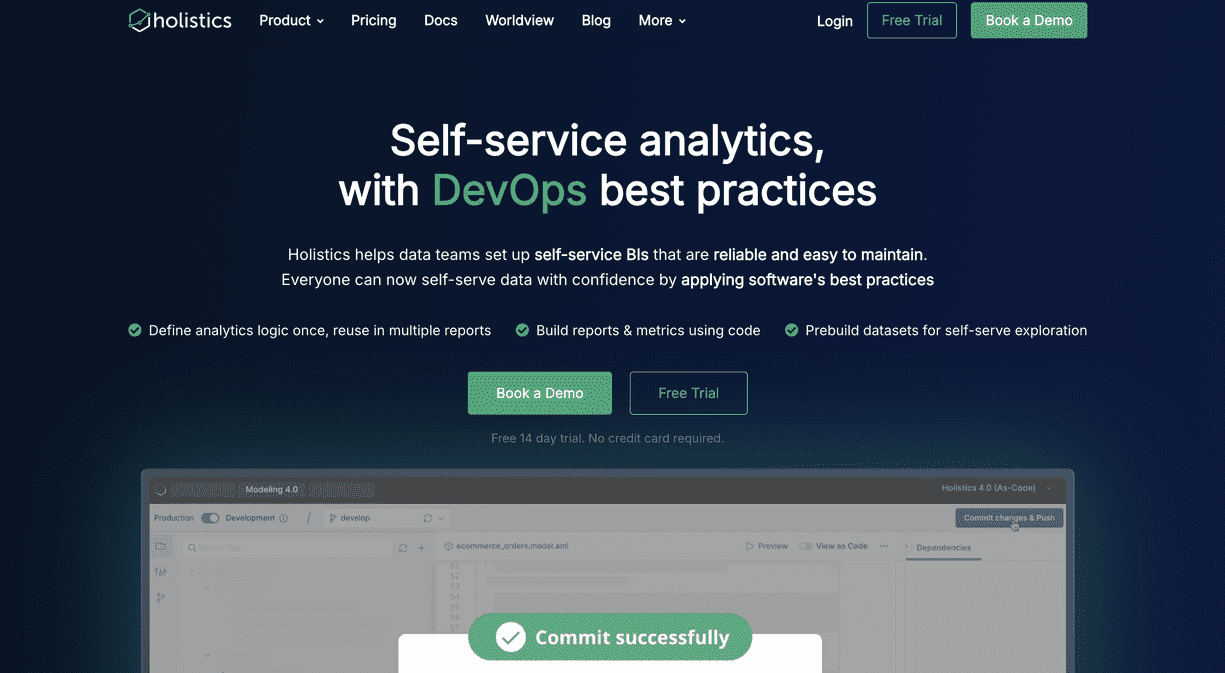
Holistics integrates with Snowflake and provides a modeling layer based on its Analytics Modeling Language (AML), which allows data teams to define metrics, joins, and business logic in version-controlled code. Dashboards and reports are then built on top of these reusable definitions, ensuring consistent metric definitions across the organization.
Holistics supports scheduled reports, automated exports, and an exploration interface for non-technical users who want to slice data without touching SQL. It's designed for data teams that value governance and reusability over fast, ad-hoc exploration. Teams that need a lightweight tool or don't want to invest in modeling up front may find Holistics heavier than necessary — but for organizations where metric consistency is critical, it's a strong fit.
Key features
- SQL-based semantic modeling layer (AML) with Git version control
- Reusable metrics and dataset definitions shared across dashboards
- Scheduled email reports and automated data exports
- Self-service exploration for non-technical users built on modeled data
- Snowflake integration alongside other major warehouses
What users say about Holistics
The data modeling as code is great and it's much cheaper than Looker, especially for small teams. Being able to version-control our metric definitions and share them across dashboards has reduced a lot of inconsistency in our reporting.
Pricing
Holistics offers tiered pricing starting at $29/month, with Business plans at $49/month and enterprise tiers available for larger teams.
Implementing your Snowflake reporting tool effectively
Choosing the right Snowflake reporting tool is only half the job. A tool gives you the capability — but it won't deliver consistent value without thoughtful implementation and ongoing adoption. Like any part of your data stack, success depends on how well you integrate it into your team's actual workflow.
Here's how to get the most out of whichever Snowflake reporting tool you choose.
1. Onboarding your team
Invest in proper onboarding from the start. Developers, data analysts, product managers, and anyone responsible for reporting should understand how the tool works before they're expected to use it in pressure situations. A short, focused session on day one prevents future bottlenecks and avoids the kind of misconfigurations that lead to misread metrics or data quality issues.
2. Start with a pilot
Instead of rolling dashboards out to the whole organization at once, start with a small, representative group. A controlled pilot helps you validate metric definitions, refine access controls, and confirm that the dashboards you built actually answer the questions people have. It's also far easier to catch and fix issues in a pilot than after a company-wide launch.
3. Collect feedback continuously
Reporting is not a set-it-and-forget-it feature. Once dashboards go live, actively gather feedback from users — both internal and customer-facing — on what's working and what needs adjustment. As your data model evolves and your product grows, your reporting layer should evolve alongside it.
4. Monitor performance and usage
Track which dashboards are viewed regularly, which queries run most frequently, and which reports are rarely opened. If certain dashboards never get clicked, refine or retire them. If certain queries are slow, investigate query optimization or warehouse scaling. Understanding how your team interacts with analytics helps you measure the ROI of your reporting investment and improve over time.
Conclusion
The Snowflake reporting tool you choose becomes the lens through which your team and your customers understand data. It shapes how quickly insights surface, how confidently decisions get made, and how well your product communicates value to users. It needs to be reliable, responsive, and consistent with the standards your organization already maintains.
If you want a reporting layer that works directly with Snowflake — without extra pipelines, modeling overhead, or warehouse migrations — tools like Draxlr help you ship dashboards quickly while keeping your stack simple. Whether you need internal visibility, customer-facing analytics, or embedded dashboards inside your product, the right tool should help you move fast without compromising on data quality or security.
If you'd like to explore a Snowflake-native approach to dashboards and reporting, you can try Draxlr and see how it fits your workflow.
FAQs
1. What is a Snowflake reporting tool?
A Snowflake reporting tool connects directly to your Snowflake data warehouse and lets you build dashboards, charts, and reports without writing SQL for every request. These tools let teams explore live warehouse data safely and share insights without setting up ETL pipelines or additional infrastructure.
2. Can I build customer-facing dashboards on top of Snowflake?
Yes. Several reporting tools support embedding dashboards inside your product when Snowflake is the underlying data source. Look for options with secure embed tokens, row-level filtering for multi-tenant data models, and styling controls so dashboards match your product's UI.
3. Does Snowflake have built-in reporting?
Snowflake includes Snowsight, a web-based interface for running queries and building basic visualizations. However, Snowflake has announced that legacy Snowsight dashboards will be deprecated in June 2026, making dedicated reporting tools increasingly necessary for teams that rely on dashboards.
4. Is it safe to connect a reporting tool directly to Snowflake?
Yes, provided the tool uses secure authentication (OAuth or key pair), respects your Snowflake role-based access controls, and doesn't copy or extract data outside the warehouse. Most modern reporting tools built for Snowflake meet these standards. Always verify the tool's security documentation before connecting production data.
5. Can non-technical team members use Snowflake reporting tools?
Yes. Choose a tool that offers visual query builders, saved reports, dashboard filters, and easy sharing so non-technical users can work with Snowflake data without writing SQL. Tools like Draxlr, Sigma Computing, and Metabase are specifically designed for mixed-skill teams.
6. Do I need to move data out of Snowflake to use a reporting tool?
No. The best Snowflake reporting tools push queries directly to your warehouse and return results in real time. There is no need to export data, maintain a secondary copy, or run ETL pipelines. Direct connections are faster to set up, easier to maintain, and keep your data in the secure environment where it already lives.
About the author

Vivek is a coder and the founder of Draxlr who cares deeply about building good products. He works at the intersection of AI, SQL, dashboards, and embedded analytics, with a strong focus on making complex data workflows feel simple, useful, and fast for real teams.
If you have questions about anything in this guide, or want to compare options for your specific stack, you can email Vivek at vivek@draxlr.com, try Draxlr free, or reach out directly through the Draxlr team.