Best Toucan Toco Alternatives in 2026
Compare the best Toucan Toco alternatives for embedded analytics in 2026, including Draxlr, Luzmo, Embeddable, Qrvey, GoodData and Sisense, on RLS, SQL access and pricing.
The best Toucan Toco alternatives for embedded analytics in 2026 are Draxlr, Luzmo, Embeddable, Qrvey, GoodData and Sisense. All six put dashboards inside your product and keep each customer to their own rows. They differ in how much your customers can do once the analytics are embedded, whether you have to build a semantic layer first, how the embed reaches your frontend, and how the price scales as customers use the product.
Draxlr hands your customers a SQL editor and a no-code query builder inside your app, with row-level security applied as each query runs. Toucan and Luzmo both keep SQL on the vendor side, so a customer who wants to write their own query has nowhere to write it. Draxlr's embedding starts at $75/month flat with unlimited customer viewers, and row-level security and full app embedding start at $250/month.
This guide compares the tools on what decides an embedded analytics project: what customers can build for themselves, tenant isolation, modeling effort, embed method, deployment and published pricing. Vendor details were checked against each vendor's own pricing pages and documentation on 22 October 2026.
Why do teams look for Toucan Toco alternatives?
Toucan Toco is the company behind Toucan, which it now sells as Toucan Studio. It made its name on data storytelling for business users, and the current product has been rebuilt around AI. Studio sells embedded conversational analytics, where your customers ask questions in plain language and get charts back without SQL or BI training, grounded in a governed semantic layer with row-level security deciding what each one sees. Analytics render inside your app through a web component or React SDK rather than an iframe, white-labeling covers colors, fonts and component styles with a theme per tenant, and no Toucan branding is visible to your end users (Toucan embedded dashboards).
It is also unusually open about commercial terms for this market. Prices are published, every plan includes unlimited users, and hosting sits in France by default, in Scaleway's DC3 datacenter, with a Docker-based self-hosted option for regulated industries (Toucan FAQ). Older comparisons still quote an €890 entry price and a Scale plan, but Toucan's own pricing page on 22 October 2026 lists only Start, Grow and Enterprise.
Customers rate it well, at 4.7 out of 5 across roughly 180 reviews on G2. The complaints that do come up are a learning curve for new users and limits on customizing individual charts (Toucan reviews on G2).
Teams usually compare Toucan Toco alternatives for reasons of ceiling and cost shape:
- AI usage is metered in credits. Start includes 50,000 credits, which Toucan describes as roughly 1,000 answers a month, and Grow doubles that to about 2,000, shared across every tenant you serve (Toucan pricing). Most embedded analytics tools meter AI this way but what makes the meter bite harder here is that the conversational answer is the only route your customers have to the data, so once a month's credits are spent they have no query builder or SQL editor to fall back on.
- A semantic layer comes before answers. Toucan grounds its AI in a governed semantic layer, so somebody models the data before a customer can ask anything. That is good governance and real setup work.
- No SQL for your customers. Across Toucan's pricing page, embedded dashboard page and FAQ, embedded end users ask questions, get AI-built dashboards on the Grow plan and export to PDF or CSV. A query builder or SQL editor for those users is not offered.
- Governance features sit on a custom plan. SSO, alerting, scheduled PDF reports, managed storage and dedicated infrastructure are all Enterprise, which is quote-only.
What should you look for in a Toucan Toco alternative?
- What customers can do. Viewing dashboards, asking an AI, building their own dashboards, or writing their own queries are four different ceilings. Decide which one your customers are asking for before you shortlist.
- Where the tenant rule is enforced. In a signed embed token, in a workspace per tenant, on a prepared dataset, or in code you write. A filter the browser can change is not security.
- Modeling effort before launch. Whether you point the tool at a database and start, or build a semantic layer and define metrics first.
- Embed method. Web component, framework SDK or iframe, and whether your frontend team ends up owning chart code.
- How the price moves. Flat, per workspace, per viewer, or metered on usage. If it is metered, check whether the meter sits on the feature your customers use every day.
- Deployment. SaaS only, or your own cloud account, VPC or data center, and on which plan.
What are the best Toucan Toco alternatives?
| Tool | Best for | Customer self-service | Published price |
|---|---|---|---|
| Draxlr | SaaS teams whose customers want to query their own data, not just read a dashboard | Dashboards, no-code queries, raw SQL, saved queries, AI | Yes: $75, $250, from $500/month. Flat, unlimited viewers |
| Luzmo | Teams that want an embedded dashboard editor with SDKs for every major framework | Dashboards, charts, own data, AI. No raw SQL | Yes: from €1,995/month billed annually, plus usage |
| Embeddable | Developer-led teams that want dashboards as code in their own repository | Only what your developers ship | No. Flat subscription |
| Qrvey | SaaS vendors that need analytics running in their own cloud account | Own reports, AI assistant | No. Flat-rate or perpetual licence |
| GoodData | Multi-tenant products that need governed metrics across many workspaces | Analytics in their own workspace | No. Platform fee plus a charge per workspace |
| Sisense | Enterprises that need deep SDK embedding and on-premise deployment | Dashboards and widgets you expose | No. Quote-based |
| Toucan (for reference) | Teams whose customers want answers in plain language rather than a query tool | AI questions, AI dashboards on Grow. No raw SQL | Yes: €445 and €990/month, plus credits. Enterprise custom |
Draxlr publishes this guide. Details for the other tools come from each vendor's own pricing pages and documentation, checked on 22 October 2026.
1. Draxlr
Best for SaaS teams whose customers want to query their own data, not just read a dashboard
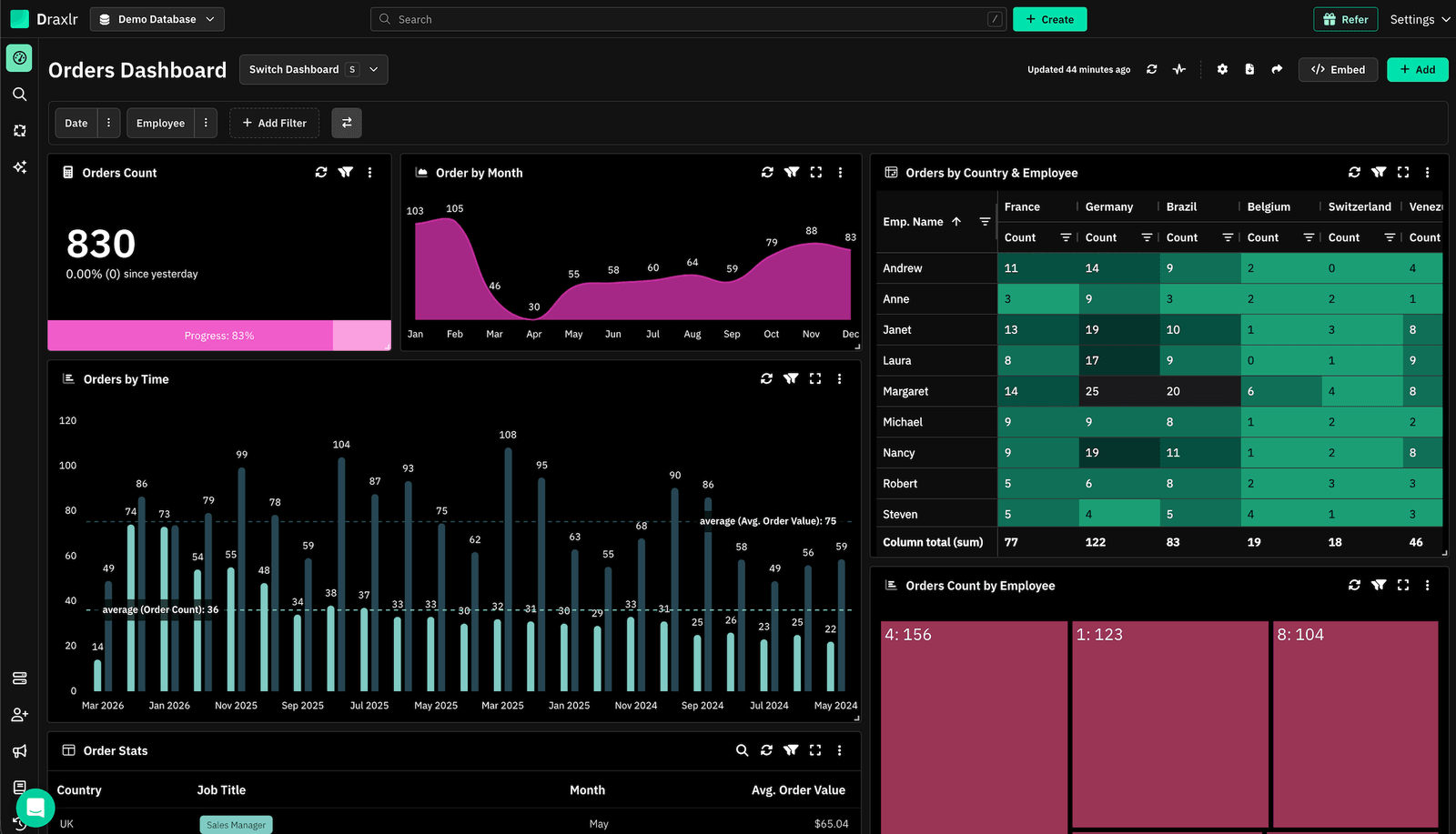
Draxlr is an embedded analytics platform that runs every query live against your SQL database. There is no copy of your data to keep in sync and no model to build before the first dashboard loads. It connects to PostgreSQL, MySQL, SQL Server, Snowflake, BigQuery, Redshift, ClickHouse, Databricks and six more SQL sources, and teams such as Comcast and Deel run both internal reporting and customer-facing analytics on it.
- Customer self-service: on the Power plan, full app embedding gives each customer their own analytics workspace inside your product. They open the dashboards you share and build their own dashboards and saved queries with a no-code query builder, a SQL editor and the AI assistant, and they don't count as Draxlr users (full app embedding docs). From Premium, you can also embed white-labeled dashboards with filters and drill-downs using HTML, React or Vue, and add row-level security to them on Power (dashboard embed docs).
- Multi-tenancy: on the Power plan, row-level security keeps each customer to their own rows, whether you embed a single dashboard or the full app. You set the rule once, and it applies to everything that customer sees or asks, including shared dashboards, the SQL they write and the AI assistant, with nothing to redo for each new dashboard (RLS docs).
- AI: Draxlr AI writes the SQL, runs it, shows the query it used and explains the result, and it can build a whole dashboard from one prompt. Because the SQL is visible, customers can check an answer and edit the query. AI messages draw on a monthly credit pool shared across your tenants, while the query builder and SQL editor don't, so customers keep working once the pool is spent.
- Pricing: published and flat, with unlimited customer viewers. Premium is $75/month for white-labeled dashboard embedding, Power is $250/month and adds row-level security and full app embedding, and Enterprise starts at $500/month with SSO, audit logs and self-hosting. SQL alerts to Slack and email come on every plan and scheduled email reports start on Premium, while Toucan lists alerting and PDF reports only on Enterprise. The 7-day Power trial needs no credit card (embedded analytics pricing).
- Watch out for: Draxlr connects to SQL databases and warehouses only, so data in NoSQL stores, REST APIs or spreadsheets needs a pipeline into SQL first. Row-level security and full app embedding need the Power plan. AI is metered, at 300 credits a month on Power with 200 more for $10, so price in the AI volume your customers will actually ask for.
2. Luzmo
Best for teams that want an embedded dashboard editor with SDKs for every major frontend framework
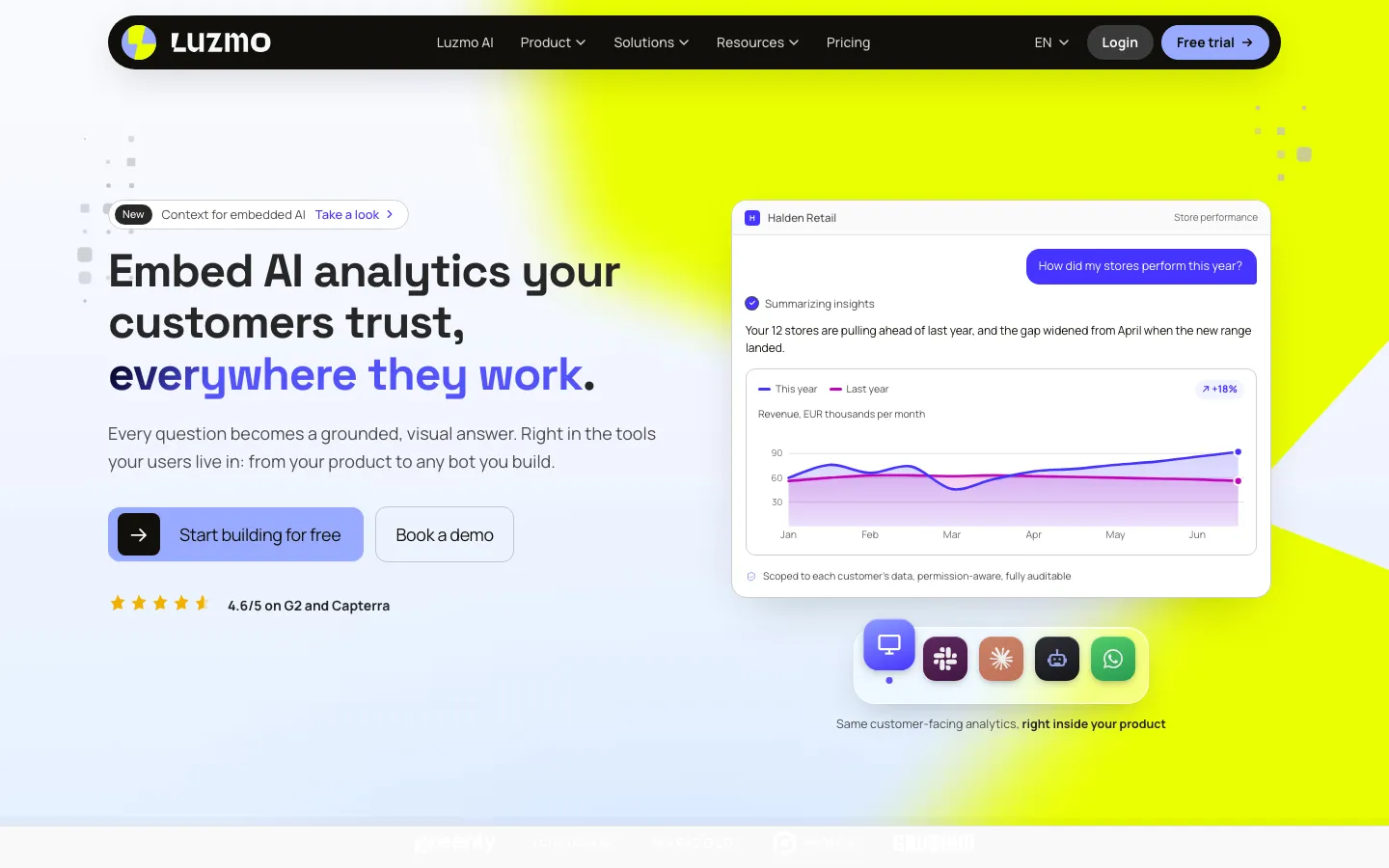
Luzmo runs as managed SaaS and embeds dashboards as a web component, with React, Vue, Angular and React Native wrappers. White-labeling is included.
- Customer self-service: build and edit dashboards in an embedded drag-and-drop editor and upload their own data. SQL stays on the vendor side, in Luzmo's dataset and query panels.
- Multi-tenancy: parameter filters set on the dataset and overridden per user in the embed token.
- AI: Luzmo IQ answers plain-language questions as text or charts.
- Pricing: one plan, "Embedded Everywhere", from €1,995/month billed annually, with usage above the included AI conversations and synced rows billed on top (Luzmo pricing).
- Watch out for: the entry price is more than four times Toucan's Start plan, and SQL access is the main gap in a head-to-head with Draxlr.
3. Embeddable
Best for developer-led teams that want dashboards as code in their own frontend
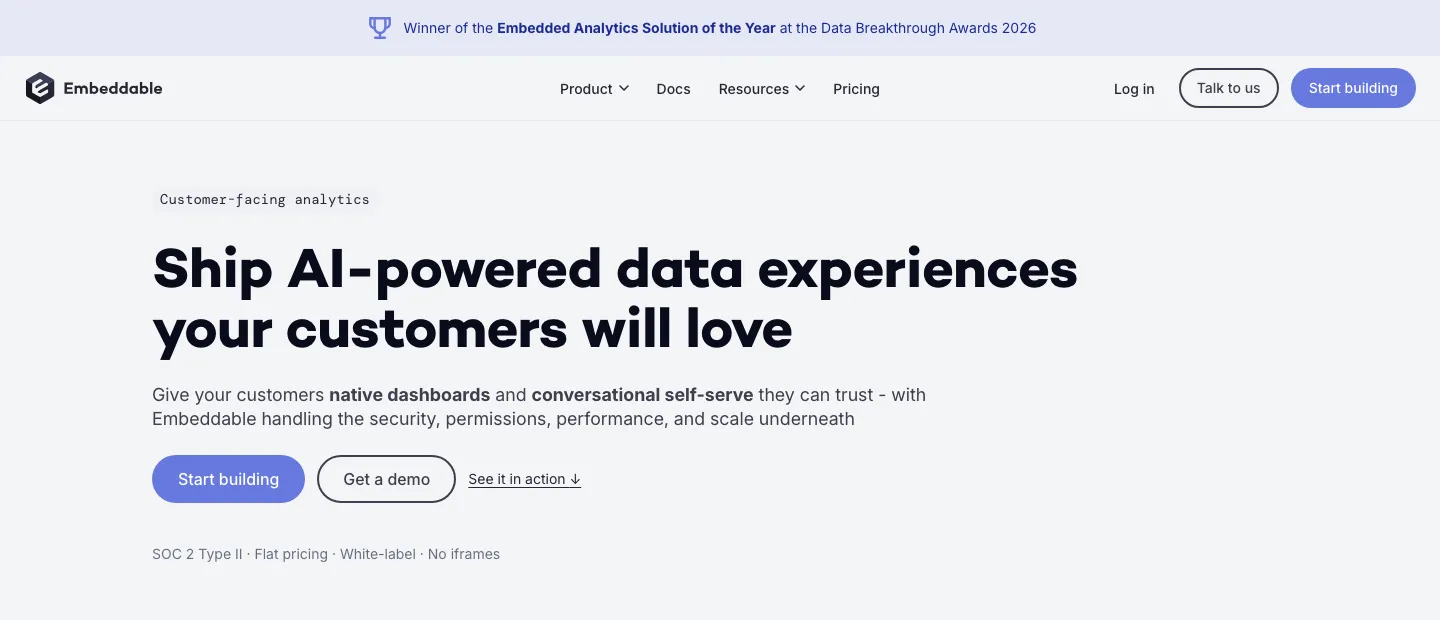
Embeddable ships dashboards as a web component for React, Vue or Angular. Charts are written in React and data models run on Cube, so dashboards and models live in your repository.
- Customer self-service: customers use the dashboards and components your developers ship.
- Multi-tenancy: a security context passed to the Tokens API drives security filters, SQL rules or access policies, and a query fails if a filter can't be applied.
- AI: AI chat is advertised, but the end-user chatbot is marked as a prototype in the docs.
- Pricing: not published. Plans are a flat monthly subscription (Embeddable pricing).
- Watch out for: modeling in Cube and building components needs developers on your side.
4. Qrvey
Best for SaaS vendors that want embedded analytics running in their own cloud account
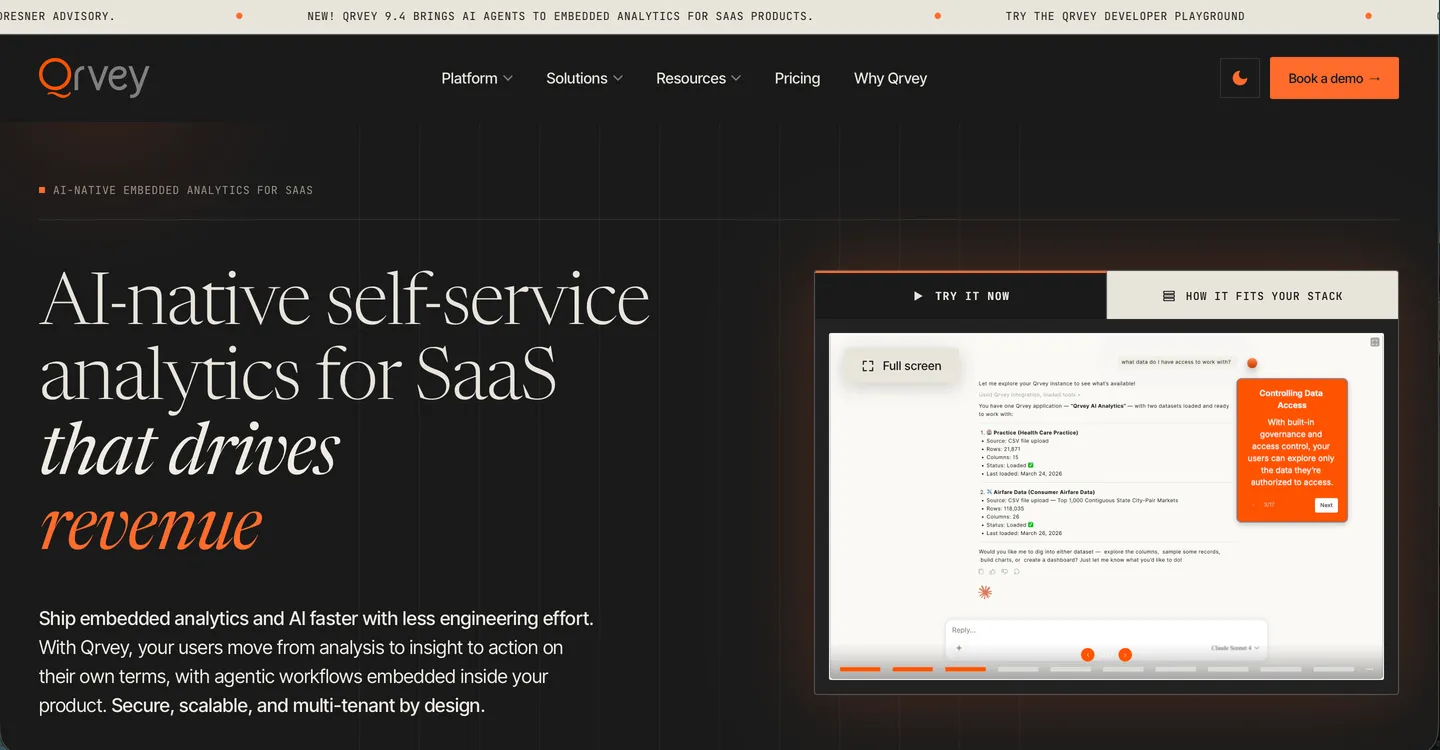
Qrvey deploys into your own AWS account, and Qrvey says it also runs on Azure and GCP. Analytics embed as JavaScript widgets built as web components.
- Customer self-service: customers can build their own dashboards and reports inside your app.
- Multi-tenancy: record-level security filters carried in a token your backend generates.
- AI: Sidekick, an embedded conversational assistant, plus AI agents.
- Pricing: not published. Flat-rate plans or a perpetual licence (Qrvey pricing).
- Watch out for: you run and upgrade the infrastructure yourself. Live Connect datasets query your warehouse directly, so joins and formulas come from a SQL query you write against the source, some transformations and calculated fields are limited, and nothing is stored in Qrvey, which means historical snapshots need a managed dataset instead (Qrvey Live Connect docs).
5. GoodData
Best for multi-tenant SaaS products that need governed metrics across many customer workspaces
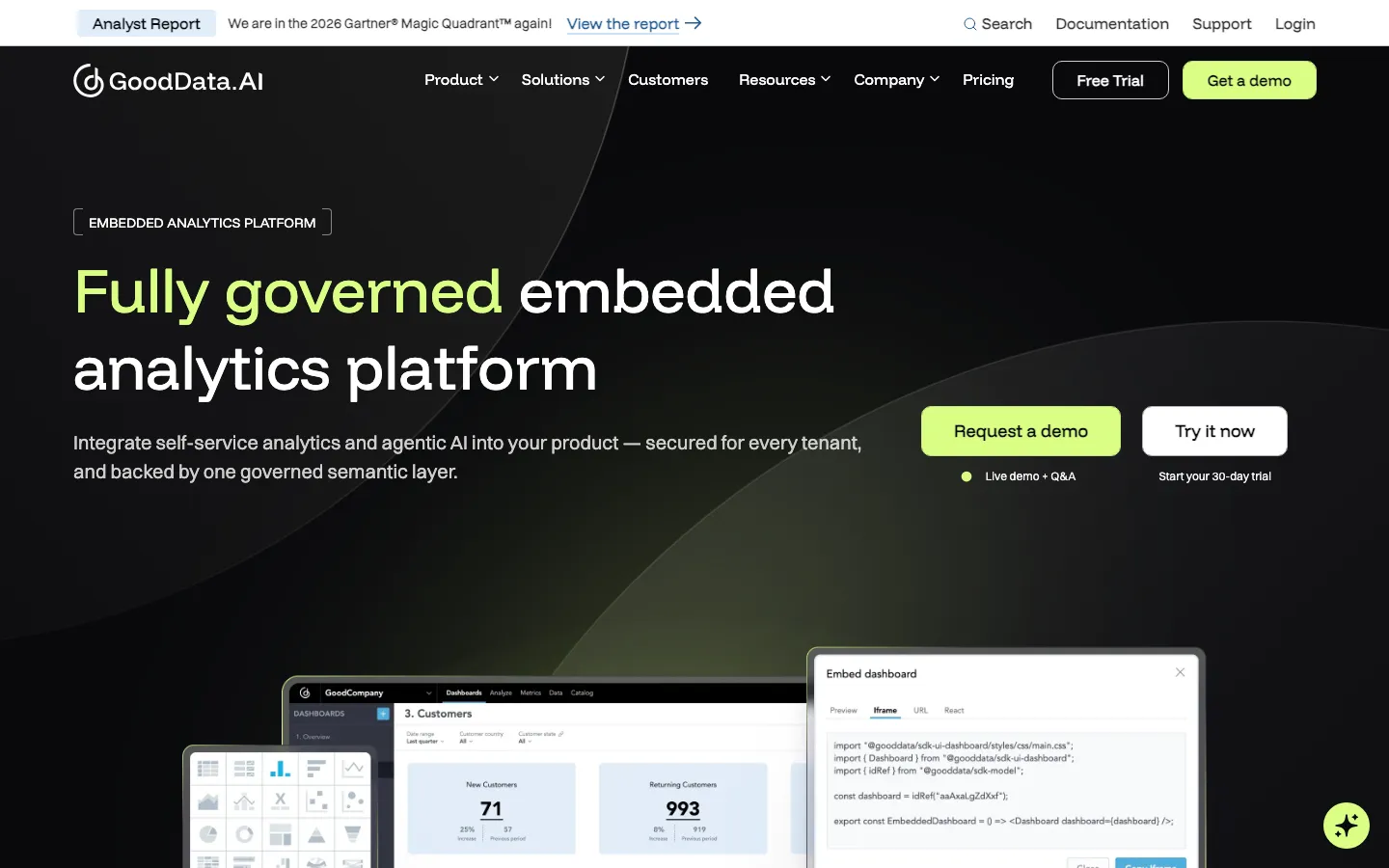
GoodData is a modeling-first analytics platform that gives each customer a workspace. You embed with iframes, web components or a React SDK.
- Customer self-service: self-serve analytics inside their own workspace.
- Multi-tenancy: a workspace per tenant, with workspace and user data filters for row-level security.
- AI: the AI assistant and copilots are Enterprise features.
- Pricing: not published. A platform fee plus a charge per workspace, so cost rises with the number of tenants (GoodData pricing).
- Watch out for: you build a logical data model and learn MAQL, GoodData's own query language, before your first customer sees a chart.
6. Sisense
Best for software vendors that need deep SDK embedding and on-premise options
Sisense embeds with iframes or the Compose SDK for React, Angular and Vue, on ElastiCubes that import your data or live models that query your warehouse.
- Customer self-service: explore dashboards and build widgets, depending on the roles you give them.
- Multi-tenancy: data security rules give row-level access.
- AI: Sisense Intelligence includes an assistant and an MCP server.
- Pricing: not published. An S&P Global 451 Research note from February 2026 reported self-serve plans at $399 and $1,299 a month, with fixed viewer and designer limits (451 Research note).
- Watch out for: self-contained multitenancy with separate users, SSO and branding per tenant, on-premise deployment and full white-labeling all sit on Enterprise.
What else shows up on Toucan shortlists?
Explo still appears on many Toucan shortlists, but Omni acquired it in October 2025 and is moving every Explo customer onto Omni before the platform shuts down. Starting a new embedded project on Explo today means planning a second migration.
Metabase is the open-source name on most lists, and its open-source edition is free to self-host. The advanced embedding features and row-level security a multi-tenant product needs start on the Pro plan at $575 a month for the first 10 users, plus $12 a month for each additional user (Metabase pricing).
Yellowfin comes closest to the data storytelling Toucan built its reputation on, with Stories and Signals adding narrative and automated anomaly detection to dashboards. Pricing is quote-based.
Domo Everywhere extends Domo dashboards to external customers and partner portals. It suits enterprises already running Domo internally, since you buy the whole Domo platform to get the embedding.
Power BI, Tableau and Looker show up on general BI comparison sites. All three are built for internal reporting first, and each licenses customer-facing embedding separately from its internal BI seats.
Which Toucan Toco alternative is right for you?
| If you need | Start with |
|---|---|
| A full analytics app embedded in your product, with an AI assistant that shows customers the SQL behind every answer and row-level security on everything they ask | Draxlr (Power plan) |
| An embedded dashboard editor with React, Vue and Angular SDKs | Luzmo |
| Dashboards as code that your frontend team owns | Embeddable |
| Analytics running inside your own AWS account | Qrvey |
| Governed metrics across many tenant workspaces | GoodData |
| A mature embedding SDK with on-premise deployment | Sisense |
| Plain-language answers for customers who will never write a query, hosted in the EU by default | Stay on Toucan |
What is the best Toucan Toco alternative?
For most SaaS teams leaving Toucan, the best alternative is Draxlr. Your customers keep what they liked about Toucan, asking questions in plain English and getting answers from AI, and they also get the part Toucan leaves out. They can open the SQL behind any answer, edit it, save it and build their own dashboards on top, and row-level security keeps each customer to their own rows across all of it. Draxlr queries your SQL database live, publishes its pricing and keeps customer viewers unlimited, with white-labeled dashboard embedding from $75/month and row-level security and full app embedding from $250/month.
Pick another tool when one requirement outweighs the rest. Luzmo suits teams that want an embedded dashboard editor with SDKs for every major framework, Embeddable suits developers who want dashboards as code, and Qrvey suits products that must run analytics in their own cloud account. GoodData fits governed metrics across many tenant workspaces, and Sisense fits deep SDK embedding with on-premise deployment.
Whichever you shortlist, test it against your real database, your tenant model and the number of customers you expect before you sign.
FAQs
1. What is Toucan Toco?
Toucan Toco is the company behind Toucan, an embedded analytics platform sold as Toucan Studio. It started as a data storytelling tool for business users and now centers on conversational AI, where a software product's customers ask questions in plain language and get charts back, grounded in a governed semantic layer. It embeds through a web component or React SDK, is hosted in France by default and also offers a Docker-based self-hosted deployment.
2. How much does Toucan Toco cost?
Toucan publishes its Studio pricing. Start is €445/month and Grow is €990/month, both excluding tax, with 15% off when billed yearly, and Enterprise is custom. All plans include unlimited users, and there is a 14-day free trial. AI usage is metered in credits, with 50,000 credits on Start, which Toucan describes as about 1,000 answers a month, and 100,000 on Grow. Its Custom Apps managed service is quoted separately. Older comparisons quote an €890 entry price and a Scale plan, neither of which appears on Toucan's pricing page as of 22 October 2026.
3. Who are Toucan Toco's main competitors?
In embedded analytics, Toucan Toco competes most directly with Draxlr, Luzmo, Embeddable, Qrvey, GoodData and Sisense, with Yellowfin, Domo Everywhere and Metabase also appearing on shortlists. Explo used to be a common pick, but Omni acquired it in October 2025 and is moving its customers onto Omni. Of these, Draxlr is the pick when your customers want to write their own queries, since it gives them a SQL editor and a no-code query builder inside your app, with row-level security applied as each query runs.
4. Can Toucan Toco users write their own SQL?
No. Toucan's embedded end users ask questions in plain language, get AI-built dashboards on the Grow plan and export to PDF or CSV. A query builder or SQL editor for embedded users is not offered on Toucan's pricing page, embedded dashboard page or FAQ. Draxlr's full app embedding, on the Power plan, gives each customer a SQL editor, a no-code query builder and their own saved queries, with row-level security applied as the query runs.
5. Which Toucan Toco alternatives support row-level security for multi-tenant SaaS?
All six isolate tenant data, in different ways. Draxlr applies row-level security from an RLS group and attribute values sent with the embed token, on the Power plan. Luzmo sets parameter filters on the dataset and overrides them per user in the embed token, Embeddable reads a security context passed to its Tokens API, Qrvey carries record-level security filters in a server-generated token, GoodData combines a workspace per tenant with workspace and user data filters, and Sisense uses data security rules.
6. Is there a Toucan Toco alternative that doesn't need a semantic layer?
Yes, Draxlr. It connects directly to PostgreSQL, MySQL, Snowflake, BigQuery and other SQL sources and queries them live, with no modeling layer to build first. Customers can also write SQL against the same live tables, with row-level security applied as each query runs. Toucan, Embeddable, GoodData, Qrvey and Sisense all need a semantic layer, data model or prepared datasets before the first chart, and Luzmo keeps datasets and their SQL on the vendor side.
7. Is there a self-hosted Toucan Toco alternative?
Yes. Draxlr's Enterprise plan runs self-hosted with Docker in your VPC or on-premise, or on a dedicated server. Qrvey deploys into your own AWS account, Embeddable lets you self-host the Cube layer, and GoodData and Sisense offer self-hosted or on-premise options on Enterprise plans. Toucan itself also offers a Docker-based self-hosted deployment.
8. Is there an open-source Toucan Toco alternative?
Metabase is the best-known open-source option, and its open-source edition is free to self-host. The advanced embedding features and row-level security a multi-tenant product needs start on its Pro plan at $575 a month for the first 10 users, plus $12 a month for each additional user. If what you need is self-hosting rather than open source, Draxlr's Enterprise plan runs with Docker in your own VPC or on-premise, with row-level security, full app embedding and the AI assistant for your customers included.
9. How hard is it to move from Toucan Toco to another tool?
Dashboards don't transfer between embedded analytics tools, so plan to rebuild your most-used dashboards first. Moving to Draxlr removes a step, because there is no semantic layer to recreate. You connect the same database, rebuild dashboards with the query builder, SQL or AI, replace the embed snippet, and send each customer's RLS group and attribute values with the embed token so row-level security carries over.
About the author

Ameena is the founder of Draxlr, a modern business intelligence platform focused on making data analysis simpler and faster. She writes about embedded analytics, databases, SQL, dashboards, and building scalable data products for modern teams.
If you have questions about anything in this guide, or want to compare options for your specific stack, you can try Draxlr free, or reach out directly through the Draxlr team.