Best Sisense Alternatives in 2026
Compare 10 Sisense alternatives for 2026, including Draxlr, Tableau, Power BI, Holistics, and Zoho Analytics, with real pricing, embedding, and who each suits.
If you're evaluating Sisense alternatives, you're not alone. Sisense is a serious analytics platform, purpose built for embedded analytics, complex data modeling, and enterprise scale. But serious comes at a cost. Pricing is entirely custom and opaque, the implementation timeline is measured in weeks or months, and many teams find themselves over-paying for features they don't fully use.
If Sisense was on your shortlist or you're already a customer looking to explore other options, this guide covers the best Sisense alternatives in 2026, with honest coverage of features, pricing, and who each tool actually serves well.
What Is Sisense?
Sisense is an analytics platform built for embedding dashboards and insights inside other applications. Teams either load data into Sisense's in-memory Elasticube models or keep a live connection to their data warehouse, then build dashboards on top. Developers embed those dashboards with iFrames, the Embed SDK, or the API-first Compose SDK, and recent releases add an AI assistant and MCP connectivity for conversational analytics.
That depth is why Sisense shows up on enterprise shortlists. It is also why smaller teams start comparing alternatives once they see the implementation effort and the sales-led pricing.
Why Teams Look for Sisense Alternatives
Steep learning curve. The Elasticube data modeling environment is one of the most commonly raised friction points. Data modeling in Sisense is powerful but cumbersome, and data sources often require ongoing manual maintenance. Teams without a dedicated BI engineer regularly struggle to get full value from the platform, and onboarding new analysts takes significantly longer than with more modern tools.
Reliability issues with the cache layer. Elasticube build failures are a recurring operational headache. When builds fail, errors are difficult to diagnose, and some cube builds can trigger server errors that take down the environment entirely. For teams running production analytics that stakeholders depend on daily, this kind of unpredictability is a serious concern.
Limited flexibility for dashboard customization. Basic formatting tasks that feel standard in other BI tools often require JavaScript workarounds in Sisense. Teams that need fine grained control over dashboard presentation frequently hit a ceiling and find themselves working around the platform rather than with it.
Slow performance on larger datasets. As data volumes grow, Sisense can become noticeably sluggish. Charts can take a long time to refresh or fail to load entirely. Elasticubes become unstable when pushed beyond a certain size, and optimizing for performance typically requires infrastructure investment that wasn't initially planned for.
Expensive and non-transparent pricing. Unlike most competitors, Sisense doesn't publish pricing publicly. Every engagement goes through a sales process, which makes it difficult to budget, benchmark, or compare options quickly. For teams that aren't large enterprises with a dedicated embedded BI budget, the cost and the process of finding out that cost can both be blockers.
Complex implementation. Getting Sisense production ready, especially for embedded use cases, requires significant technical resources and time. Many small teams simply don't have the runway for that.
Overkill for many use cases. Sisense is designed for enterprise scale, complex data environments. If your needs are more straightforward such as dashboards, SQL querying, and team reporting, Sisense's complexity becomes friction rather than value.
Support quality at lower tiers. Smaller customers often report slower response times and less dedicated support compared to enterprise accounts.
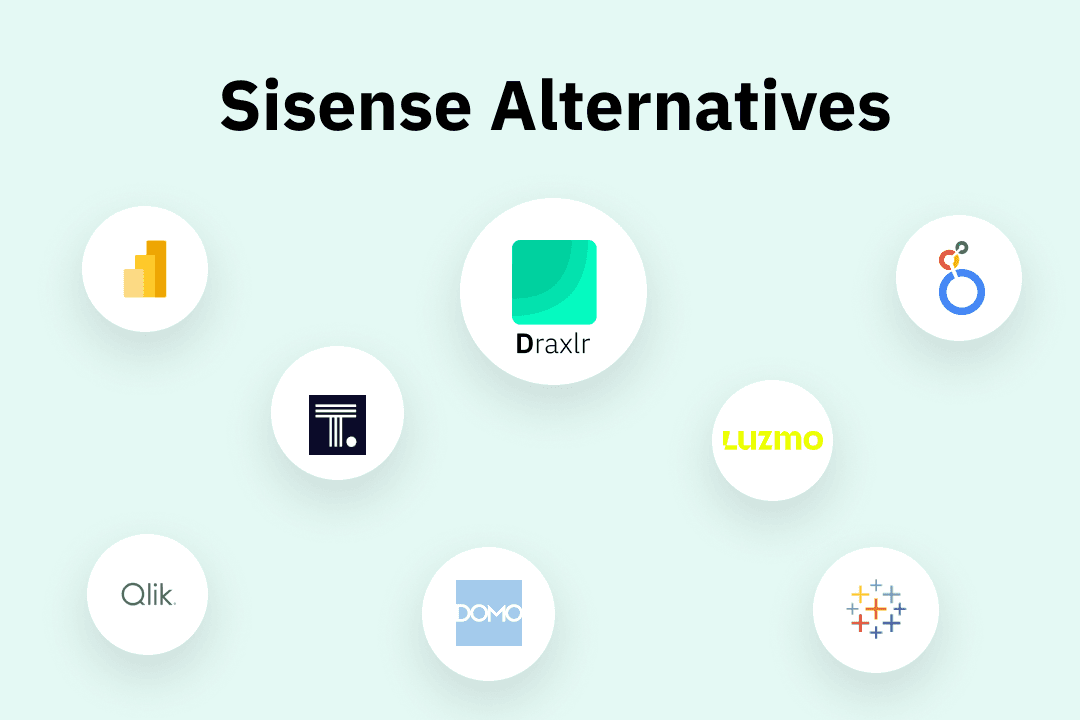
Quick Comparison: Best Sisense Alternatives in 2026
| Tool | Strengths | Ideal For | Free Trial |
|---|---|---|---|
| Draxlr | AI querying, white label embedding, transparent pricing, fast setup | SaaS teams needing embedded analytics without enterprise complexity | Yes |
| Tableau | Best-in-class visualizations, wide data connector support | Analyst teams prioritizing rich, interactive dashboards | Yes |
| Power BI | Deep Microsoft integration, affordable per-user pricing | Organizations already using Microsoft 365 or Azure | Yes |
| Looker | Governed semantic layer, strong Google Cloud integration | Large enterprises needing consistent business logic across reports | No |
| Domo | 1,000+ connectors, strong collaboration and storytelling tools | Business users needing self-service without IT dependency | Yes |
| Qlik Sense | Associative engine, surfaces hidden data relationships | Enterprise teams exploring complex, multi-source datasets | Yes |
| ThoughtSpot | Search-first AI analytics, natural language queries | Organizations wanting Google-like search as their analytics interface | Yes |
| Luzmo | Purpose-built SaaS embedding, multi tenancy by default | SaaS companies embedding analytics natively inside their product | Yes |
| Holistics | Code-based semantic modeling, Git workflow, self-service exploration | Data teams that want governed, consistent metrics defined as code | Yes |
| Zoho Analytics | Free plan, low entry pricing, Zia AI assistant, Zoho app integrations | Small and mid-sized businesses on a tight budget | Yes |
1. Draxlr
Best Sisense Alternative for Self-Serve SQL Based Analytics
Draxlr is a modern BI tool built around SQL databases with a strong focus on embedded analytics and ease of use. Where Sisense requires a complex implementation to get embedded analytics running, Draxlr embeds with HTML, React, or Vue, so developers can ship analytics inside their application in hours.
The platform connects to 10+ SQL databases including PostgreSQL, MySQL, BigQuery, Databricks, Snowflake, Redshift, Supabase, ClickHouse, and more and offers a complete analytics layer with AI powered Text-to-SQL querying, visual dashboard builder, drill downs, pivot tables, alerts, and automated reporting.
What genuinely differentiates Draxlr is its accessibility. Non technical users can build dashboards using the visual query builder or by asking questions in plain English via the AI assistant. Technical users get full SQL access with version control and complex joins. Both user types can work in the same platform.
Key Features
- AI powered Text-to-SQL for natural language queries
- Connects to PostgreSQL, MySQL, BigQuery, Databricks, Snowflake, Redshift, Supabase, ClickHouse, SQL Server, and more
- Visual query builder with nested grouping, aggregation, virtual columns, and filters
- Complete visualization suite with charts, pivot tables, drill downs, drill throughs, and compute cards
- Embedded analytics via HTML, React, and Vue
- White-label embeds with your brand colors and domain restrictions
- Row-level security for embeds, so each customer sees only their own data (Power plan)
- Full App Embedding gives each customer their own analytics workspace with dashboards, a query builder, a SQL editor, and the AI assistant (Power plan)
- Dedicated server or self-hosted deployment on the Enterprise plan
- Automated alerts on data thresholds and anomalies
- Scheduled PDF exports and email report delivery
- 7 day free trial, no credit card required
Pricing
- Lite at $25/month covers 1 database, 1 user, and 50 AI credits
- Premium at $75/month covers 2 databases, 10 users, 100 AI credits, and white-label dashboard embedding with multi-tenant filters
- Power at $250/month covers 5 databases, 30 users, 300 AI credits, row-level security for embeds, and Full App Embedding
- Enterprise starts at $500/month with custom limits, SSO, audit logs, and a dedicated server or self-hosted deployment
- Embed viewers are unlimited on every plan and don't count as users
Best for
SaaS companies, product teams, and data driven businesses that need embedded analytics without enterprise complexity or pricing.
Why Draxlr over Sisense
Draxlr is faster to implement, more transparent in pricing, and better suited for teams that don't need enterprise scale complexity. For SaaS companies embedding analytics into their product, Draxlr's HTML, React, and Vue embedding and white-label capabilities match Sisense's core value proposition at a fraction of the cost and complexity.
Connect your Database2. Tableau
Best Sisense Alternative for Visualization First Analytics Teams
Tableau's visualization capabilities remain industry leading. Its drag and drop interface lets analysts build complex, interactive dashboards without code, and it supports a wide range of data connections. Tableau also has strong embedded analytics capabilities via Tableau Embedded Analytics.
The limitations are per seat pricing that can get expensive at scale, and that building complex, governed data models requires significant setup.
Pricing
Starts at $15/user/month
Best for
Analytics teams that prioritize sophisticated, interactive data visualization and you have a dedicated analyst team working with diverse data sources.
3. Power BI
Best Sisense Alternative for Microsoft Stack Organizations
Power BI is the most widely deployed BI tool globally and offers strong visualization, a deep connector library, and tight Microsoft integration. Its per user pricing is affordable at small scale, though it gets complex with Premium capacity licensing for larger deployments. It also requires DAX expertise for advanced data modeling.
Pricing
Starts at $14/user/month, paid yearly
Best for
Organizations already using Microsoft 365, Azure, or Excel and you have technical users for data model development.
4. Looker
Best Sisense Alternative for Governed Semantic Layer Analytics
Looker's strength is its LookML based semantic layer, which enforces business logic consistently across all reports. It's deeply integrated with Google Cloud and BigQuery. The significant barriers are its $60,000/year starting price, no free trial, and the LookML expertise required to make it work.
Pricing
Starts at $60,000/year
Best for
Large enterprises that need a rigorous, organization wide semantic layer for consistent business definitions.
5. Domo
Best Sisense Alternative for Business User Self Service
Domo is built for business teams with strong data storytelling features, an app store of 1,000+ pre built connectors, and collaboration tools built in. It's more accessible than Sisense for non technical users. The downside is custom pricing that isn't publicly listed and an interface that some technical users find limiting.
Pricing
Custom, not published. Contact sales.
Best for
Organizations where business users need to self serve data without IT dependency.
6. Qlik Sense
Best Sisense Alternative for Associative Data Exploration
Qlik's associative engine is genuinely differentiated. It surfaces relationships in your data as you filter, helping analysts discover insights that traditional BI tools miss. It's enterprise scale, supports complex governance, and has strong embedding capabilities via its APIs.
Pricing
Business plan at around $300/month, Enterprise pricing is custom
Best for
Enterprise teams exploring complex, multi source datasets where relationships between data are as important as the data itself.
7. ThoughtSpot
Best Sisense Alternative for AI First Search Based Analytics
ThoughtSpot pioneered search based analytics. Users type questions in natural language and get charts and insights. Its AI agent, Spotter, handles complex questions and surfaces automated insights. It's powerful for business user adoption but expensive and better suited for large teams.
Pricing
Enterprise pricing is custom. Team plan available with limited features.
Best for
Organizations that want natural language query as their primary analytics interface.
8. Luzmo
Best Sisense Alternative for SaaS Embedded Analytics
Luzmo is purpose built for embedded analytics in SaaS products. Unlike general purpose BI tools that added embedding as a feature, Luzmo is designed from the ground up to deliver analytics that live inside your product with full white labeling, multi tenancy, and row level security built in by default.
Pricing
Starts at $995/month for the Basic plan with 100 monthly active viewers, Pro at $2,050/month, and Elite at $3,100/month. Free trial available.
Best for
SaaS companies that need to embed interactive analytics natively inside their product for end users.
9. Holistics
Best Sisense Alternative for Governed, Code-Based Data Modeling
Holistics is a cloud BI platform built for data teams that want their metrics defined once and reused everywhere. Models and metrics live in code with Git-based version control, so changes are reviewed like software. Business users then explore that governed layer with drag-and-drop dashboards, without writing SQL. It offers embedded analytics as well, which makes it a fit for product teams that want consistent numbers inside their app.
The trade-off is that someone on the team needs to be comfortable with SQL and modeling as code to get the most out of it, and embedded analytics is priced separately from the core plans.
Pricing
Entry starts at $800/month and Standard at $1,000/month when billed yearly, each including the first 10 users. Embedded analytics is a separate plan priced on request. Free trial available.
Best for
Data teams that want a governed semantic layer and an engineering-style workflow for their reporting.
10. Zoho Analytics
Best Sisense Alternative for Budget-Conscious Small Businesses
Zoho Analytics is a self-service BI tool aimed at small and mid-sized businesses. It offers drag-and-drop dashboard building, Zia, an AI assistant that answers questions in plain English, and close integration with the rest of the Zoho suite. Embedded and white-label analytics are also available for teams that want to put reports in front of customers.
It is far cheaper and simpler to start with than Sisense, but plans are capped by users and data rows, so costs climb as your data grows.
Pricing
A free plan covers 2 users and 10,000 rows. Paid plans start at $24/month billed annually for 2 users and 0.5 million rows, and every paid plan has a 15-day free trial.
Best for
Small and mid-sized businesses, especially those already using Zoho apps, that want affordable dashboards without an enterprise rollout.
How to Choose the Right Sisense Alternative
Choose Draxlr if you need embedded analytics or a white label BI solution and want transparent pricing, fast setup, and a SQL native platform your whole team can use. It covers the core Sisense value proposition of embedded analytics, multi tenancy, and self hosting without the enterprise complexity.
Choose Tableau if visualization sophistication is your priority and you have analyst resources to build and maintain reports.
Choose Power BI if you're Microsoft first and want a widely supported, affordable per seat BI tool.
Choose Looker if you're a large Google Cloud enterprise that needs governed, semantic layer analytics.
Choose Domo if your primary audience is business users who need self service without SQL.
Choose Qlik Sense if you need associative analytics for complex data exploration in an enterprise context.
Choose ThoughtSpot if natural language, AI first analytics for business users is your primary use case.
Choose Luzmo if you're a SaaS company that needs analytics embedded natively inside your product, with white labeling and multi tenancy as core requirements.
Choose Holistics if your data team wants metrics modeled as code with Git workflows and a governed layer for self-service.
Choose Zoho Analytics if budget is the main constraint and you want a free or low-cost starting point, especially inside the Zoho ecosystem.
Conclusion
Sisense earns its reputation in complex, enterprise scale embedded analytics. But for teams that don't need that level of complexity, or can't justify the cost and implementation timeline, there are compelling alternatives.
Draxlr is the most well rounded Sisense alternative for SQL driven teams. It delivers embedded analytics, white labeling, self hosting, and an AI powered query interface with transparent pricing and fast setup. If you're building analytics into a SaaS product or running internal dashboards, it's worth starting a free 7 day trial at draxlr.com.
FAQs
1. What is the most affordable Sisense alternative?
Draxlr starts at $25/month with transparent pricing and unlimited embed viewers. Power BI starts at $14/user/month and is a strong budget pick for Microsoft users, and Zoho Analytics has a free plan for 2 users. All three offer far more predictable costs than Sisense's custom enterprise pricing.
2. Is Sisense good for small businesses?
Not typically. Sisense is designed for enterprise scale and pricing reflects that. Small businesses are better served by tools with transparent, flat monthly pricing and faster setup times.
3. Which Sisense alternative is best for embedded analytics?
Tools with React and Vue SDKs and white label BI options are purpose built for embedded analytics. Draxlr, Luzmo and Qlik also have mature embedding capabilities for enterprise use cases.
4. Which Sisense alternative is best for small businesses?
Draxlr is the strongest fit for small businesses. It starts at $25/month, requires no dedicated BI engineer, and can be up and running in hours. Unlike Sisense, pricing is transparent and there's no lengthy sales process.
5. Which Sisense alternative has natural language query features?
Draxlr and ThoughtSpot are the strongest options. Draxlr includes AI powered Text-to-SQL that lets users ask questions in plain English and get results instantly. ThoughtSpot is purpose built around search based analytics with its Spotter AI agent. Domo also offers natural language query capabilities for business users.
6. Is Draxlr a good Sisense alternative for enterprises?
Yes. The Enterprise plan adds SSO, audit logs, custom limits, and a dedicated server or self-hosted deployment in your private network. For customer-facing analytics, row-level security for embeds and Full App Embedding are available on the Power plan ($250/month) and above, and every embed is white-labeled.
About the author

Ameena is the founder of Draxlr, a modern business intelligence platform focused on making data analysis simpler and faster. She writes about embedded analytics, databases, SQL, dashboards, and building scalable data products for modern teams.
If you have questions about anything in this guide, or want to compare options for your specific stack, you can try Draxlr free, or reach out directly through the Draxlr team.