Secure Token-Based Dashboard Embedding: How to Build It Without Leaking Tenant Data
Embed tokens should expire in 15 minutes or less, not carry raw DB credentials — here's the JWT-based architecture that keeps one tenant's dashboard from leaking another's data
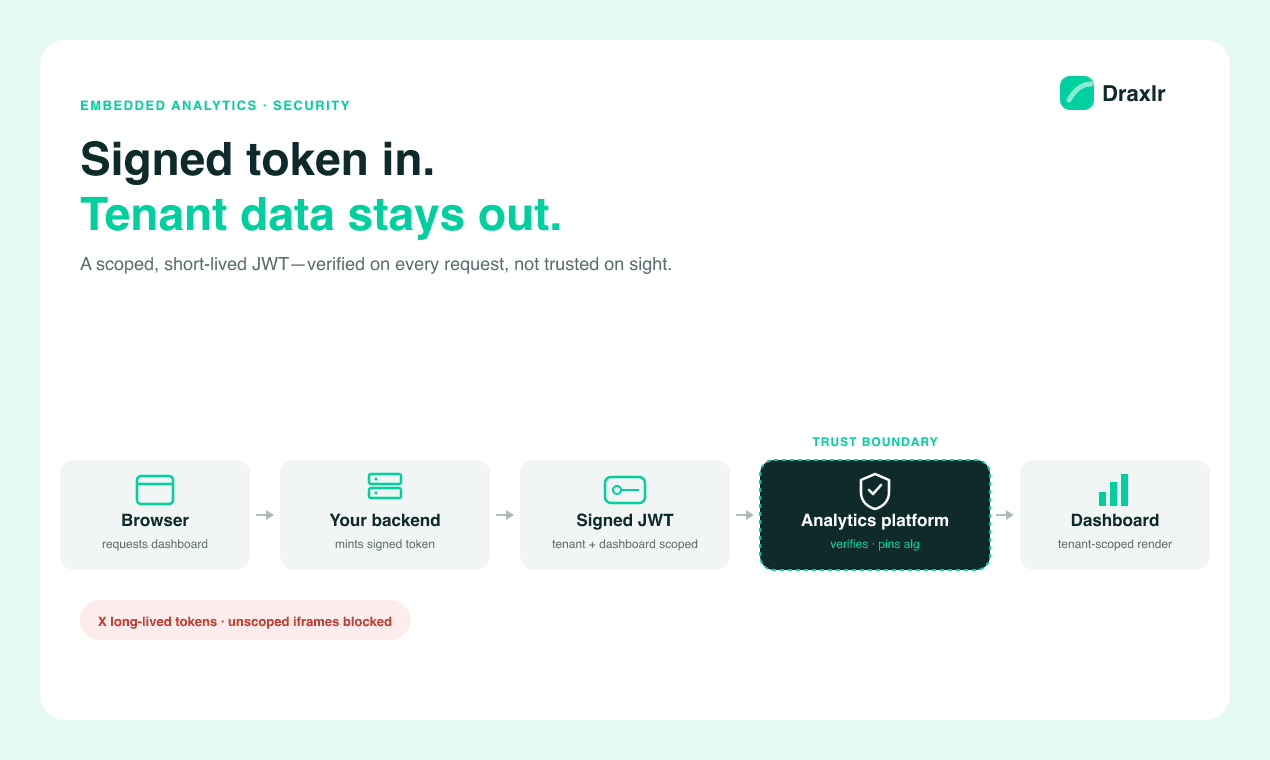
Every SaaS team that embeds a dashboard eventually asks the same question: how do we let tenant A see their chart without accidentally handing them a URL that also renders tenant B's? The answer isn't "add a tenant_id query parameter" — a query parameter is just a suggestion the browser is happy to let a user edit. The actual fix is a signed token that the embedding platform verifies server-side, on every request, before it decides what data to render.
This guide covers the real architecture: how to mint a scoped embed token, how the analytics platform must validate it, the specific ways teams leak tenant data even after they think they've "added JWT," and how to lock down the iframe or SDK surface the token rides in on.
Key Takeaways
- A signed embed token (JWT), not a raw filter parameter, is what stops a user from editing a URL to see another tenant's data — the token's claims are cryptographically tied to a signature the client can't forge.
- Access tokens should expire in 15 minutes or less (DevToolKit.cloud, 2026); long-lived embed tokens are the single most common way teams accidentally build a permanent cross-tenant leak.
- Algorithm confusion attacks — forcing a token verifier to check an RS256-signed token as if it were HS256 — drove a cluster of critical CVEs in Q1 2026, including a CVSS 10.0 finding in a widely used Java JWT library (DEV Community, 2026).
- The iframe itself needs its own guardrails:
Content-Security-Policy: frame-ancestorshas replacedX-Frame-Optionsas the modern control, and modern browsers ignore the older header entirely once the CSP directive is present (MDN, 2026).
What Is Token-Based Dashboard Embedding, and Why Not Just Share a Login?
Token-based embedding means your backend mints a short-lived, signed credential — scoped to one tenant and one dashboard — and hands it to the browser instead of a shared session or login. In 2026, over 72% of enterprises are integrating analytics directly into their own operational applications rather than pointing users at a separate BI tool (GlobalGrowthInsights, 2026), and nearly all of them face this exact trust-boundary problem.
Sharing a login (or a shared API key baked into the frontend) doesn't work because the browser is not a trusted environment. Anything sent to a browser can be inspected through developer tools, network traffic analysis, or intercepted requests (Sisense, 2026). A shared credential that works for "tenant A's dashboard" also works for "tenant B's dashboard" the moment someone changes a request parameter — there's nothing cryptographically binding the credential to a specific scope.
A signed token fixes this by making the scope part of what's being verified, not part of what's being requested. The client can see the token; it cannot forge a new one with a different tenant_id claim without the signing key, which never leaves your server.
How Do You Mint a Signed Embed Token Without Leaking Tenant Data?
The token has to carry exactly the scope the viewer is allowed to see, an expiry short enough to limit blast radius, and nothing else — no raw SQL, no connection details, no permissions beyond the one dashboard being embedded. Here's a minimal signing endpoint using the jsonwebtoken library:
const jwt = require("jsonwebtoken")

function mintEmbedToken({ tenantId, dashboardId, userId }) {
  const payload = {
    tenant_id: tenantId,
    dashboard_id: dashboardId,
    sub: userId,
    iss: "https://app.yoursaas.com",
    aud: "embed.analytics-provider.com",
  }

  return jwt.sign(payload, process.env.EMBED_PRIVATE_KEY, {
    algorithm: "RS256",
    expiresIn: "10m",
  })
}

// Called from your authenticated API route, never from the browser
app.post("/api/dashboards/:id/embed-token", requireAuth, (req, res) => {
  const { tenantId } = req.session // resolved server-side from the logged-in user
  const token = mintEmbedToken({
    tenantId,
    dashboardId: req.params.id,
    userId: req.session.userId,
  })
  res.set("Cache-Control", "no-store")
  res.json({ token })
})
Three details here are load-bearing. The tenantId comes from req.session, resolved by your own auth layer — never from a request body or query string the client controls. The token is signed with RS256 (asymmetric), so the analytics platform only needs your public key to verify it, and never holds a secret that could mint tokens itself. And the expiry is 10 minutes, inside the 15-minutes-or-less window security guidance recommends for 2026 (DevToolKit.cloud, 2026).
This is the same problem row-level security for multi-tenant analytics solves at the database layer — a tenant_id that has to be resolved from authenticated identity, never taken at face value from client input. Embedding just moves the trust boundary from your database connection to your token signature.
How Should the Embedding Analytics Platform Validate That Token?
Signature verification alone isn't enough — a verifier that trusts the token's own header to tell it which algorithm to check is exploitable. Q1 2026 saw a cluster of critical CVEs from exactly this pattern, including CVE-2026-29000, a CVSS 10.0 vulnerability in the Java library pac4j-jwt (DEV Community, 2026). The fix is to pin the expected algorithm in the verify call itself, never read it from the token:
const { expressjwt } = require("express-jwt")

app.use(
  "/embed",
  expressjwt({
    secret: PUBLIC_KEY,
    algorithms: ["RS256"], // hard-pinned — never derived from the token header
    audience: "embed.analytics-provider.com",
    issuer: "https://app.yoursaas.com",
  })
)

app.get("/embed/dashboard/:id", (req, res) => {
  const { tenant_id, dashboard_id } = req.auth

  if (dashboard_id !== req.params.id) {
    return res
      .status(403)
      .json({ error: "token does not match requested dashboard" })
  }

  const data = renderDashboard({
    tenantId: tenant_id,
    dashboardId: dashboard_id,
  })
  res.json(data)
})
Four checks matter, and skipping any one of them reopens the leak the token was supposed to close:
- Algorithm allowlist, hard-pinned in code. Never let the verifier read
algfrom the token and act on it — that's precisely howalg: noneand RS256-to-HS256 downgrade attacks work (AquilaX, 2026). issandaudclaims, checked exactly. The 2026 guidance is explicit:issmust exactly match your identity provider or auth service, andaudmust include your API or client ID (DevToolKit.cloud, 2026).exp, rejected without grace period. An expired token is not a warning — it's a hard failure.- The requested resource matches the token's scope, not just that the token is valid. A dashboard ID in the URL still needs to be compared against the
dashboard_idclaim; a valid-but-mismatched token is a different tenant's ticket to a different show.
What Are the Most Common Ways Teams Leak Tenant Data Even After Adding JWT?
"We use JWT for embedding" is not the same claim as "our embedding is secure" — most leaks happen inside an architecture that technically has a JWT step but skips one of the following.
The token is minted client-side. If the signing key (or worse, a symmetric shared secret) ships in frontend JavaScript, any user can open dev tools and mint their own token with any tenant_id they want. Signing must happen exclusively in a server process that holds the private key.
The token never expires, or expires in days instead of minutes. A token that outlives the browser session it was issued for is a standing credential — if it leaks (browser history, a shared screenshot, a proxy log), it stays valid long after the legitimate viewer closed the tab.
Tenant scope comes from the request, not the token. Some embedding integrations pass tenant_id as a URL parameter alongside a JWT that's checked for validity but never checked for whether its claims match that parameter. The token exists, but it isn't actually gating anything.
Refresh flows re-derive scope from client-supplied state. A "refresh this embed token" endpoint that trusts a tenantId sent back by the client — instead of re-resolving it from the authenticated session — reopens exactly the hole the original token was meant to close.
How Do You Lock Down the iframe or Embed Surface Itself?
A correctly scoped token stops a user from seeing another tenant's data through the embed. It does nothing to stop a malicious third-party site from framing your embed to phish credentials or intercept the token in transit — that's a separate, browser-level control.
Content-Security-Policy: frame-ancestors 'self' https://*.yourcustomer.com
frame-ancestors in your Content-Security-Policy header is the modern replacement for X-Frame-Options, and when both are present, modern browsers prioritize frame-ancestors and ignore the older header completely (MDN, 2026). Set it to an explicit allowlist of the domains permitted to embed the dashboard — never *.
| Guardrail | Enforced where | Fails safe if skipped? |
|---|---|---|
| Server-side token signing | Backend, private key never leaves it | Yes — client can't forge scope |
| Pinned algorithm on verify | Analytics platform's token verifier | No — a gap here is a full bypass |
| Short expiry (≤15 min) | Token payload (`exp` claim) | Partially — caps exposure window |
| `frame-ancestors` allowlist | CSP response header | Yes, if enforced browser-side |
| "We added JWT" as a claim | Documentation / marketing | No — not a real control |
The last row is the trap. A JWT step in the architecture diagram isn't the same thing as a JWT step that's actually verified for algorithm, issuer, audience, and scope match on every request. Treat every embed request the same way you'd treat an API call from an untrusted client — because that's exactly what it is.
Frequently Asked Questions
Is a signed JWT enough to prevent cross-tenant data leaks in embedded dashboards?
A signed JWT is necessary but not sufficient. It has to be verified with a pinned algorithm, checked iss/aud/exp claims, and its scope claims must be compared against the resource actually being requested. A token that's merely "present and valid" without a scope-match check still allows cross-tenant access if the request parameters disagree with the token.
How long should an embed token stay valid?
Security guidance for 2026 recommends access tokens expire in 15 minutes or less (DevToolKit.cloud, 2026). Most dashboard-embedding implementations use 5-15 minute tokens paired with a silent server-side refresh, so the visible session feels continuous while the underlying credential never lives long enough to matter if it leaks.
Can I use symmetric (HS256) signing instead of RS256 for embed tokens?
You can, but RS256 is generally preferable for third-party embedding because it lets the analytics platform verify tokens with only your public key — it never holds a secret capable of minting valid tokens itself. Mixing algorithms or letting a verifier accept either is what enables algorithm-confusion downgrade attacks (AquilaX, 2026).
Do I still need CSP frame-ancestors if my embed token is properly scoped?
Yes. Token scoping and framing control solve different problems. A well-scoped token stops a viewer from seeing another tenant's data; frame-ancestors stops a malicious site from framing your embed at all, which protects against clickjacking and phishing regardless of how correct your token logic is.
Conclusion
Token-based dashboard embedding solves a trust problem, not a UI problem: how does an analytics platform know which tenant's data to render without trusting anything the browser says? A signed, short-lived, scope-checked token answers that — but only if the signing happens server-side, the verifier pins its algorithm instead of trusting the token's header, and the requested resource is checked against the token's claims on every single call.
Add frame-ancestors to lock down who can frame the embed at all, and treat every request hitting your embedding endpoint the same way you'd treat any other untrusted client call — because it is one.
About the author

Vivek is a coder and the founder of Draxlr who cares deeply about building good products. He works at the intersection of AI, SQL, dashboards, and embedded analytics, with a strong focus on making complex data workflows feel simple, useful, and fast for real teams.
If you have questions about anything in this guide, or want to compare options for your specific stack, you can email Vivek at vivek@draxlr.com, try Draxlr free, or reach out directly through the Draxlr team.