Best Metabase Alternatives in 2026
Compare the best Metabase alternatives in 2026, from Draxlr and Superset to Tableau, Power BI, and Looker, by pricing, AI features, and embedded analytics.
Metabase is widely used for SQL-based analytics. It is open source, quick to connect to a database, and friendly enough for a first dashboard. But as data grows and more people need answers, many teams in 2026 are looking for more flexible, AI-assisted, and business-friendly BI tools.
Modern teams want:
- Faster insights without heavy SQL dependency
- Better dashboards for non-technical users
- Dashboard embedding at affordable rates (Metabase interactive embedding starts at $575/month on the Pro plan)
- AI assistance for querying and summarizing data
If Metabase feels limiting for your current needs, here are the best Metabase alternatives in 2026, compared side by side.
Why teams look for Metabase alternatives
Metabase is a solid starting point, but some limits tend to surface as companies scale. These are the complaints that come up most often in Metabase reviews on G2 and Capterra.
Self-service stops at the basics. Business users can filter pre-built questions, but exploring beyond them often needs someone who writes SQL. That creates a queue for the data team and slows decisions down.
Performance at scale. Metabase queries your database directly. That works well for small datasets but can turn into slow dashboards as data volumes and concurrent users grow.
Pricing that climbs with users. Metabase Starter costs $100/month for 5 users. Interactive embedding, row-level security, SSO, and white-labeling are on the Pro plan, which costs $575/month for 10 users plus $12 for each additional user. At 100 users, that is about $1,655/month on monthly billing.
The dashboard builder feels limited. Even teams that like Metabase for querying find layout, sizing, and positioning controls basic when they need presentation-ready dashboards.
Open source still needs a developer. Self-hosting Metabase is free, but someone has to handle setup, upgrades, backups, and debugging. Teams without engineering time often find the free option is not free once that time is counted.
Comparison table
| Tool | Best use case | Open source | AI capabilities | Starting price |
|---|---|---|---|---|
| Metabase | SQL driven analytics | Yes | Limited | Free (self-hosted), Starter $100/month |
| Draxlr | AI powered self service and embedded analytics on SQL databases | No | Strong | $25/month |
| Apache Superset | Open source BI for technical data teams | Yes | Limited | Free (self-hosted) |
| Redash | Lightweight SQL querying and sharing | Yes | Limited | Free (self-hosted only) |
| Tableau | Enterprise dashboards and advanced visualization | No | Moderate | $15/viewer/month, $75/creator/month |
| Microsoft Power BI | Microsoft ecosystem analytics | No | Moderate | $14/user/month |
| Looker | Governed semantic layer for large enterprises | No | Moderate | Custom quote |
| Qlik | Governed associative analytics | No | Moderate | $300/month for 10 users |
| Sisense | Embedded analytics | No | Moderate | Custom quote |
| Sigma | Spreadsheet style cloud analytics | No | Limited | Custom quote |
| ThoughtSpot | AI and search driven analytics | No | Strong | $25/user/month |
Prices are vendor list prices as of October 2026. Tableau, Power BI, Qlik, and ThoughtSpot prices are billed annually.
1. Draxlr
AI powered alternative to Metabase for SQL databases
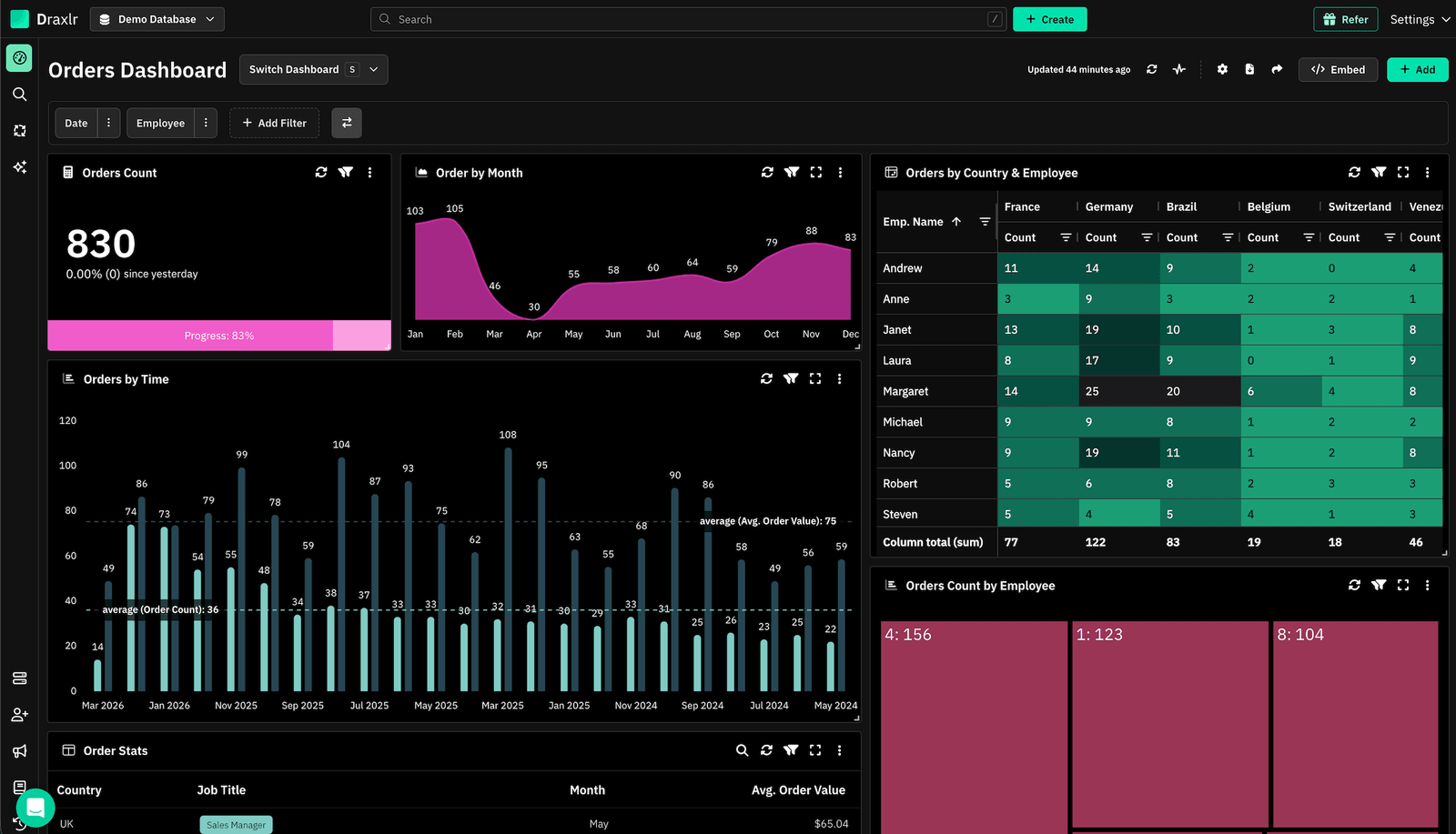
Draxlr is built for teams whose data lives in SQL databases. It connects live to PostgreSQL, MySQL, MariaDB, SQL Server, BigQuery, Snowflake, Redshift, ClickHouse, Databricks, Supabase, and more, and gives every type of user a way in: a visual query builder for business users, a SQL editor for analysts and engineers, and an AI assistant that turns plain-English questions into SQL.
- Three ways to query: visual query builder, SQL editor, and AI-generated SQL
- Dashboards with filters and drill-downs, connected to your live database
- Slack and email alerts when metrics change or cross a threshold
- Embed dashboards in your product with HTML, React, or Vue, white-labeled, with unlimited customer viewers on every plan
- Multi-tenant filters on the Premium plan ($75/month); row-level security and Full App Embedding, a complete analytics workspace for each customer, on the Power plan ($250/month)
- Plans start at $25/month, with a 7-day free trial and no credit card required
- Self-hosting available on the Enterprise plan, plus live chat and email support on every plan
Watch outs
- Built for relational SQL databases, so teams working mainly with NoSQL or time-series data may find it less suited to their stack
Best for
- Startups and SaaS teams
- Product and growth teams
- Teams without dedicated data analysts
- Teams that want analytics embedded inside their product
See how Draxlr compares feature by feature on our Metabase alternative page.
2. Apache Superset
The most popular open-source Metabase alternative
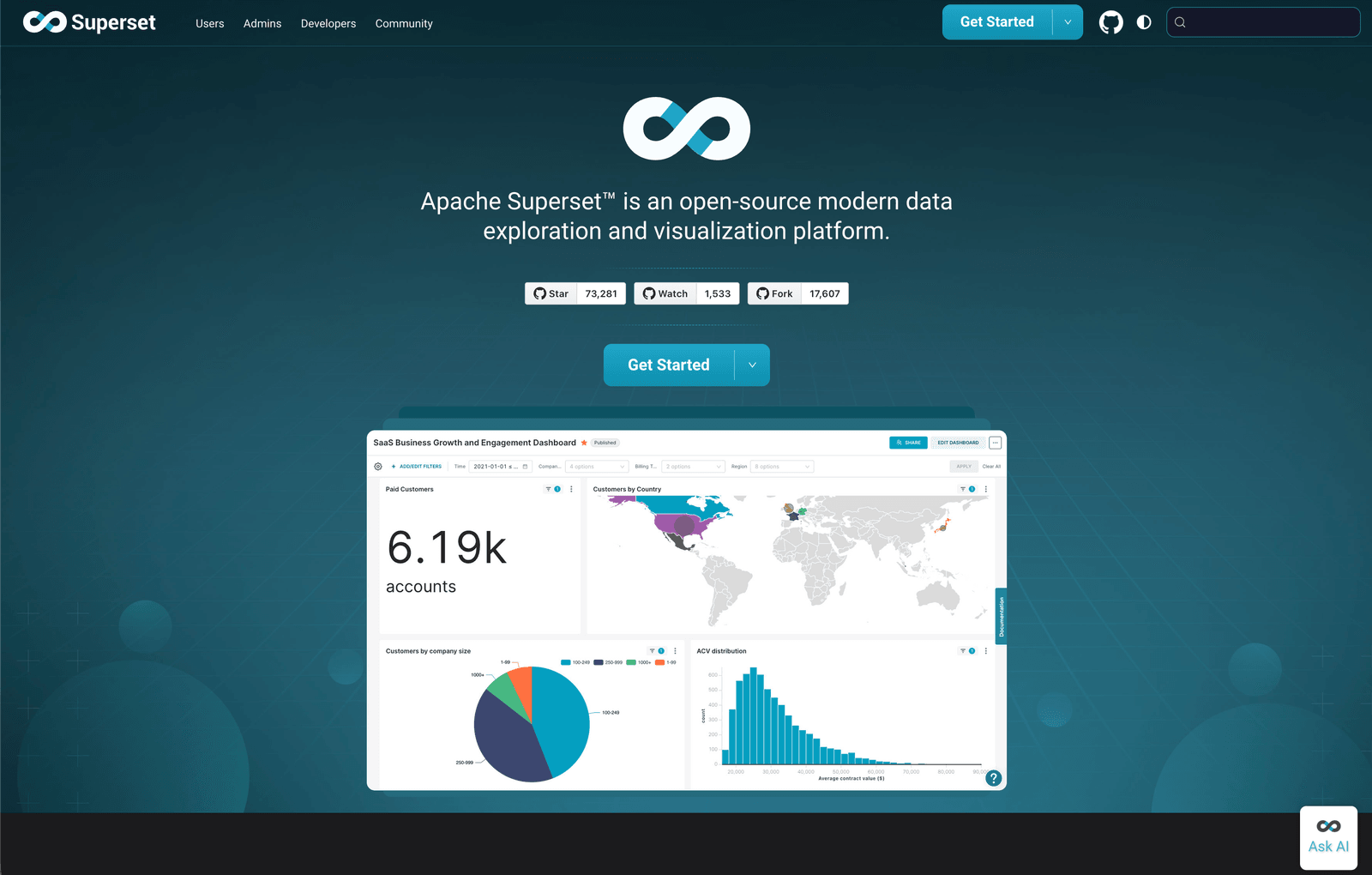
Apache Superset started at Airbnb and is now an Apache Software Foundation project with more than 75,000 GitHub stars. It pairs a no-code chart builder with a full SQL IDE.
- 40+ chart types, cross-filters, and drill-to-detail
- Connects to PostgreSQL, MySQL, BigQuery, Snowflake, Redshift, Databricks, and many more
- Row-level security and a lightweight semantic layer for custom metrics and dimensions
- Free to self-host, with managed hosting available from Preset
Watch outs
- Steeper learning curve than Metabase for non-technical users
- Heavier infrastructure to run and upgrade yourself
Best for
- Data teams that want open-source power without licensing costs
- Startups with engineers who can own self-hosting
3. Redash
Lightweight, SQL-first querying and dashboards
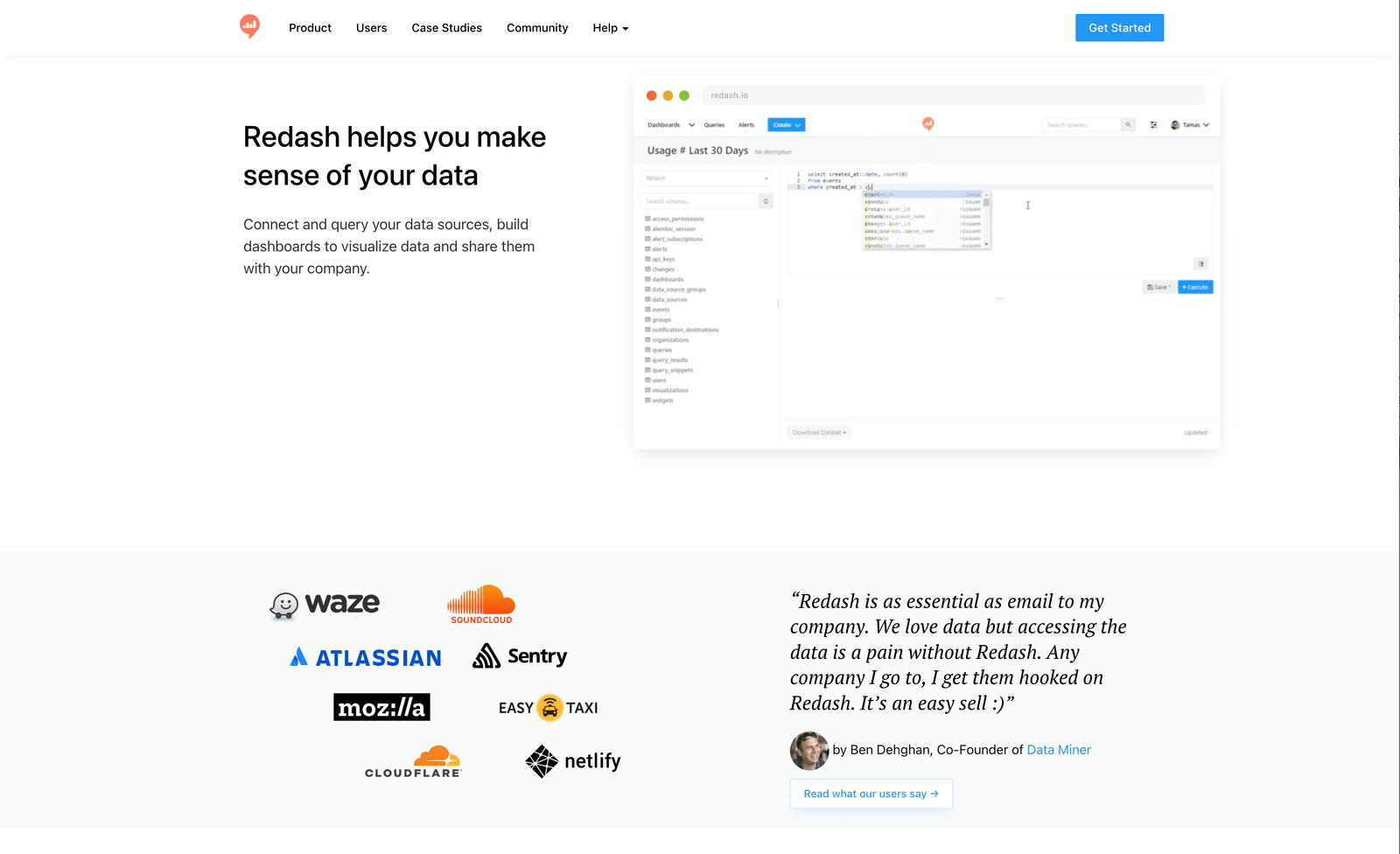
Redash is an open-source tool built around writing a query, visualizing the result, and sharing it. Its hosted service closed in November 2021 after the Databricks acquisition, so today it runs self-hosted only, maintained by the community.
- SQL editor with autocomplete and parameterized queries
- Connects to a wide range of SQL and NoSQL sources, including MongoDB
- Scheduled query refreshes, alerts, and simple dashboard sharing
- Free to self-host
Watch outs
- Fewer visualization types and a less polished UI than Metabase
- Little for business users who don't write SQL
- No vendor-hosted option
Best for
- Engineering teams that think in SQL and want a simple way to share query results
4. Tableau
Enterprise business intelligence platform for advanced visualization
- Industry leading visualization and interactivity
- Strong governance and enterprise controls
- Works across many data sources and large datasets
- Great for executive dashboards and reporting
Watch outs
- Steeper learning curve
- Higher cost at scale: Viewer seats are $15/user/month and Creator seats $75/user/month, billed annually, and every deployment needs at least one Creator
- Can be heavy for simple reporting
Best for
- Large enterprises
- Dedicated BI teams
- Advanced reporting and data storytelling
5. Microsoft Power BI
Best Metabase alternative for Microsoft ecosystem users
- Deep integration with Excel, Azure, Teams, and Office 365
- Drag and drop dashboards and reports
- Natural language Q and A features for basic insights
- Strong security and governance options for larger orgs
- Power BI Pro costs $14/user/month, billed annually
Watch outs
- Advanced capabilities may require Premium licensing
- DAX and data modeling can feel complex for smaller teams
- Power BI Desktop, the main authoring tool, runs only on Windows
- Less flexible for product embedded analytics
Best for
- Organizations already using Microsoft tools
- Finance and operations reporting
- Structured governance environments
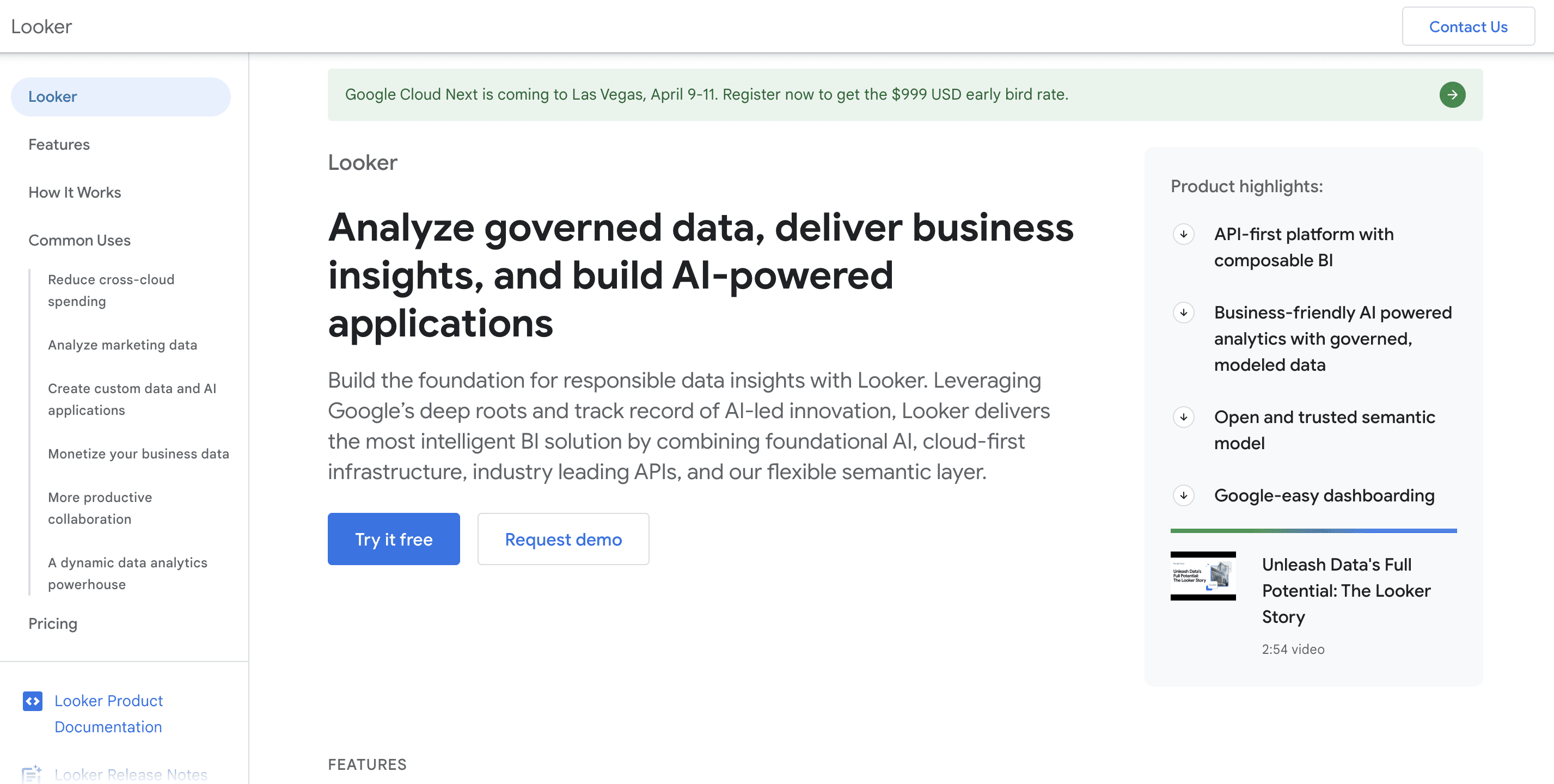
6. Looker
Governed semantic layer for large enterprises
Looker, part of Google Cloud, is built around LookML, a modeling language that defines metrics, dimensions, and relationships once in a central semantic layer. Every report reads from that layer, so teams work from the same numbers.
- Centralized semantic layer that keeps metrics consistent across teams
- Git-based version control for analytics logic
- Deep integration with BigQuery and Google Cloud
- APIs and embedding for building analytics into other apps
Watch outs
- Teams need to invest in LookML modeling before they see value
- Custom pricing through sales, typically one of the more expensive options
- Works best with dedicated analytics engineers
Best for
- Large enterprises with mature data stacks that need one governed source of truth
7. Qlik
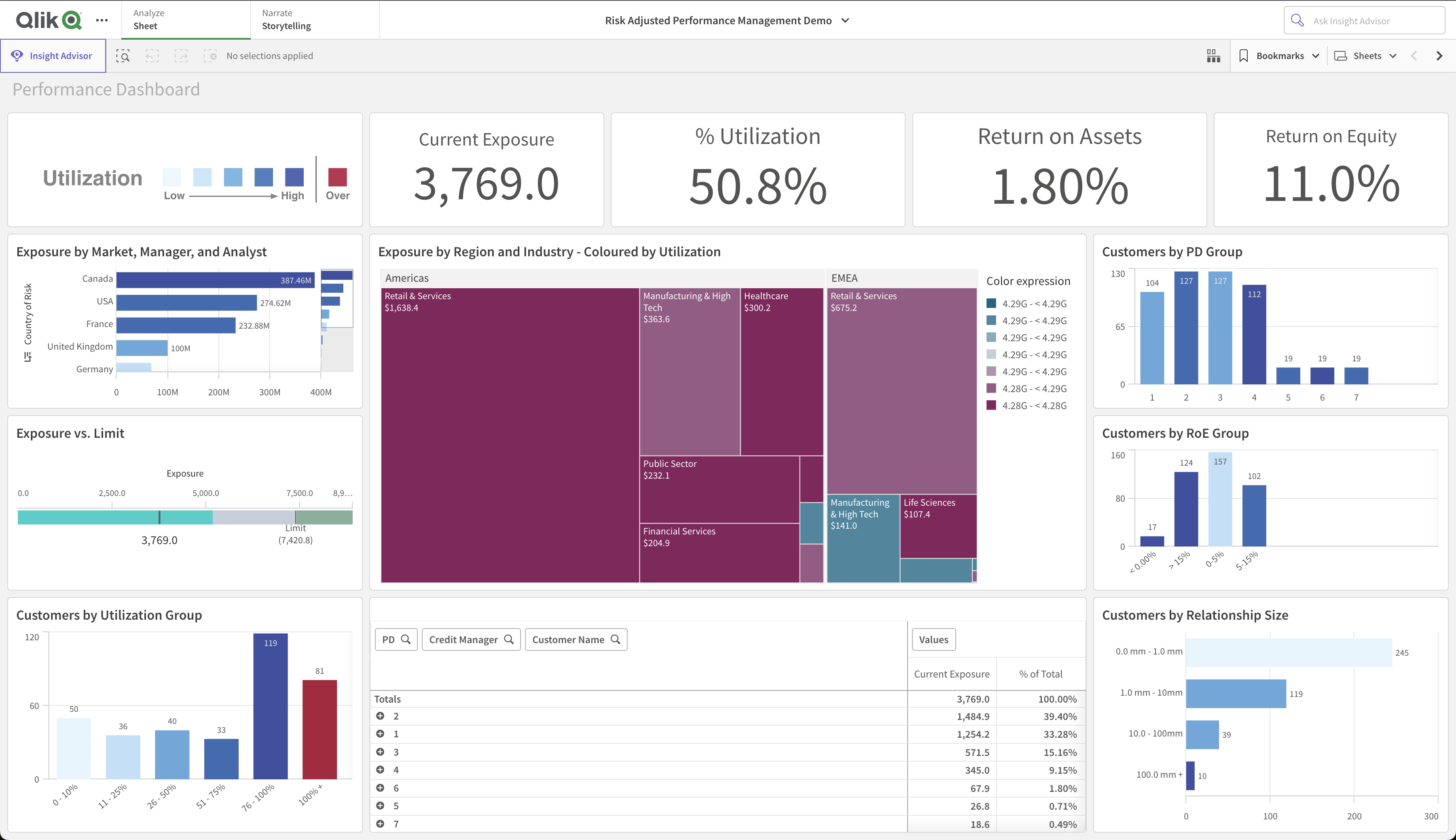
Governed Business Intelligence with Associative Analytics
- Associative data model that lets users explore data from any angle without breaking context
- Strong support for governed self-service analytics
- Handles complex, multi-source enterprise datasets well
- Advanced data preparation and transformation capabilities
- Built-in security, permissions, and audit controls
Watch outs
- Steeper learning curve for new users
- Higher cost than lightweight BI tools: Qlik Cloud Analytics starts at $300/month for 10 users, billed annually
- Less intuitive for teams looking for quick, ad-hoc insights
Best for
- Large enterprises
- Regulated industries like finance, healthcare, and manufacturing
- Teams that need strong governance and controlled analytics at scale
8. Sisense
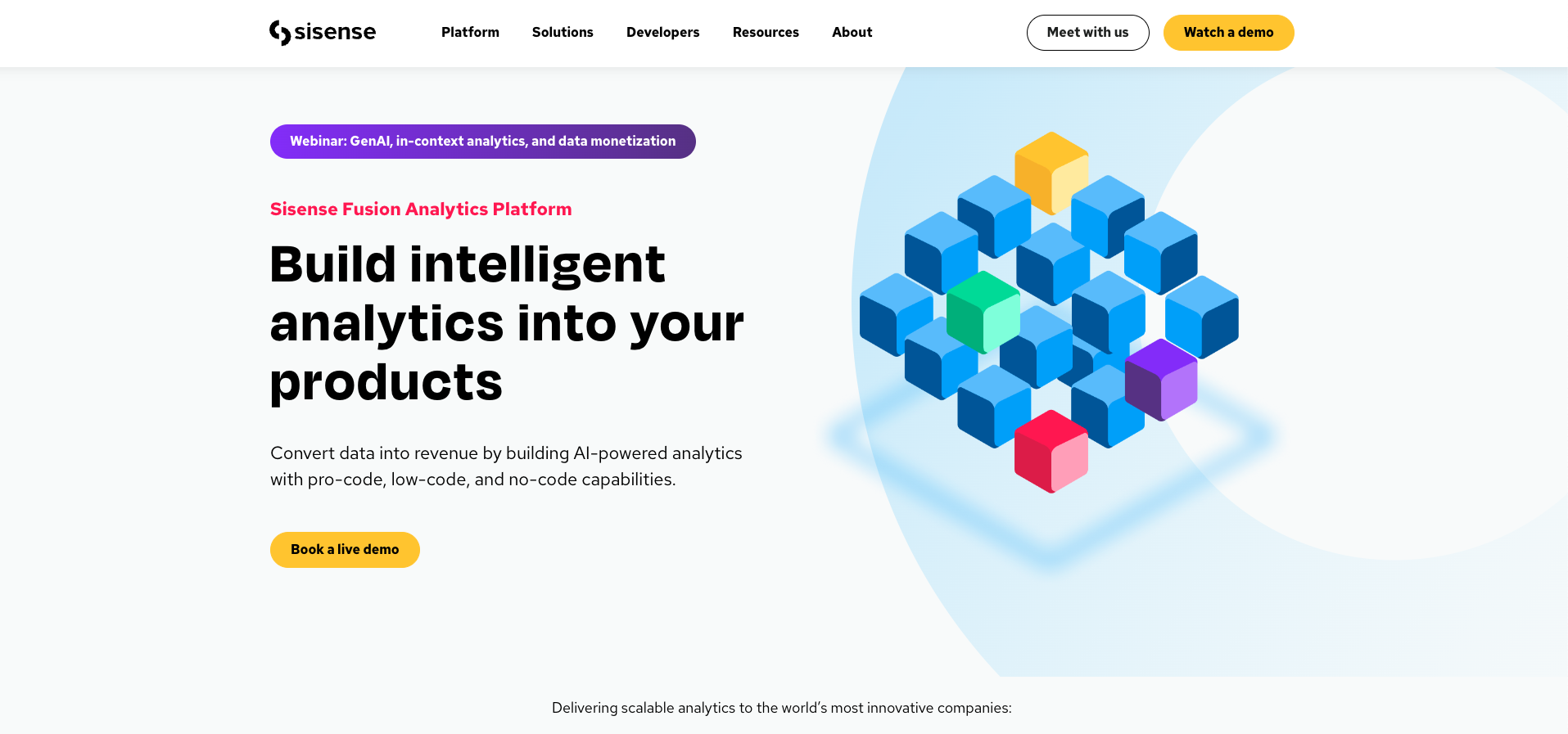
Embedded Analytics for Customer-Facing Products
- Powerful embedded analytics using APIs and SDKs
- Designed for customer-facing dashboards and reports
- Scales well for external and multi-tenant analytics use cases
- Supports a wide range of data sources and cloud warehouses
- Flexible theming and white-labeling options
Watch outs
- Setup and customization require engineering effort
- More complex than internal-only BI tools
- Custom pricing that can be high for smaller teams
Best for
- SaaS companies offering analytics to customers
- Product teams building data-driven features
- Organizations that need white-labeled or embedded dashboards
9. Sigma
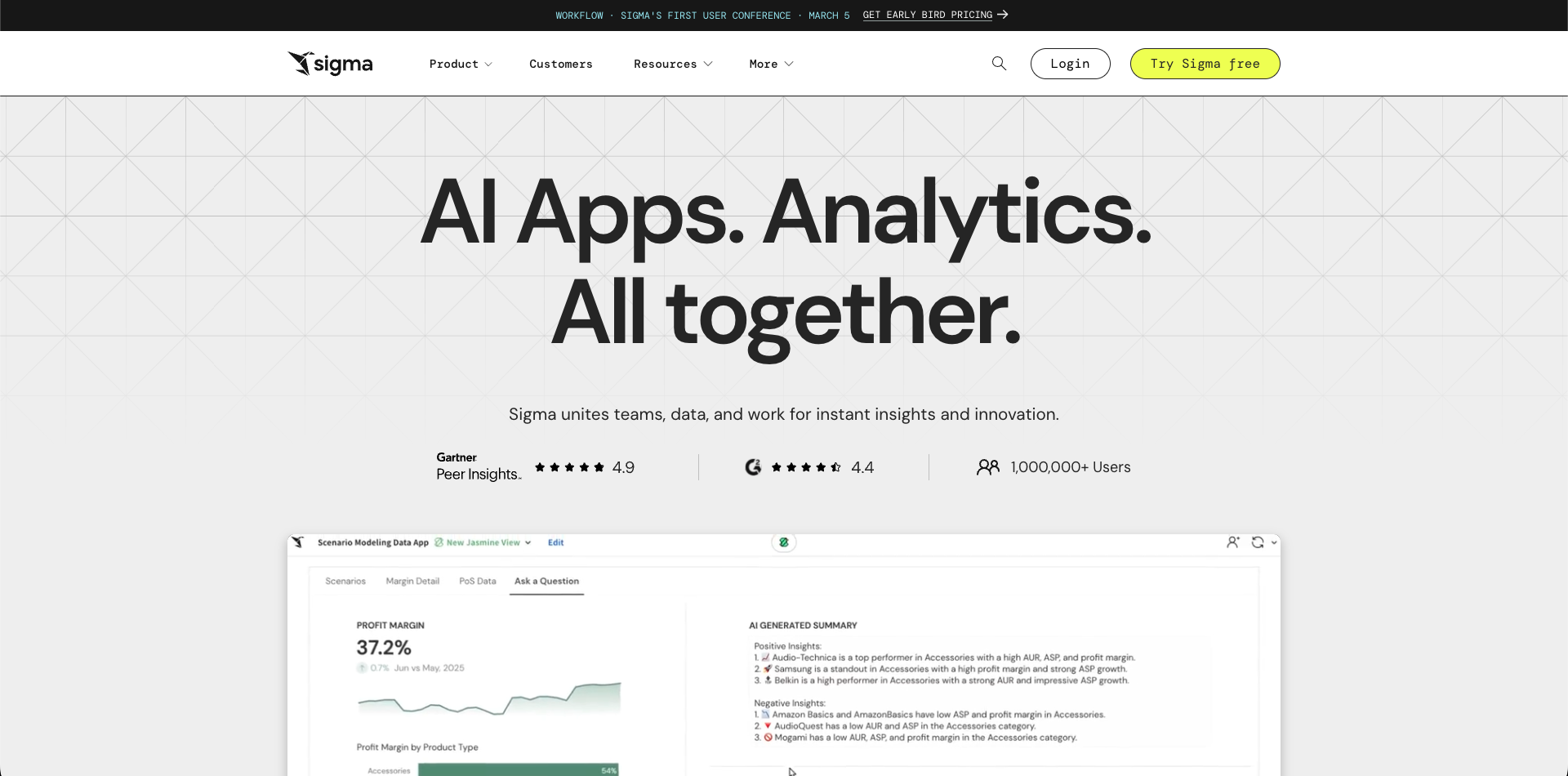
Spreadsheet style BI for cloud data warehouses
- Spreadsheet like interface with Excel-style formulas that business teams adopt quickly
- Live queries on Snowflake, BigQuery, Redshift, and Databricks
- Write-back to your warehouse for planning and data entry workflows
- Governance features like lineage and permissions
Watch outs
- Custom pricing that tends to be higher
- Best for warehouse first organizations
- Limited chart customization compared with visualization-first tools
Best for
- Cloud warehouse users
- Teams moving from spreadsheets to BI
- Analytics teams partnering with business users
10. ThoughtSpot
Search and AI driven analytics
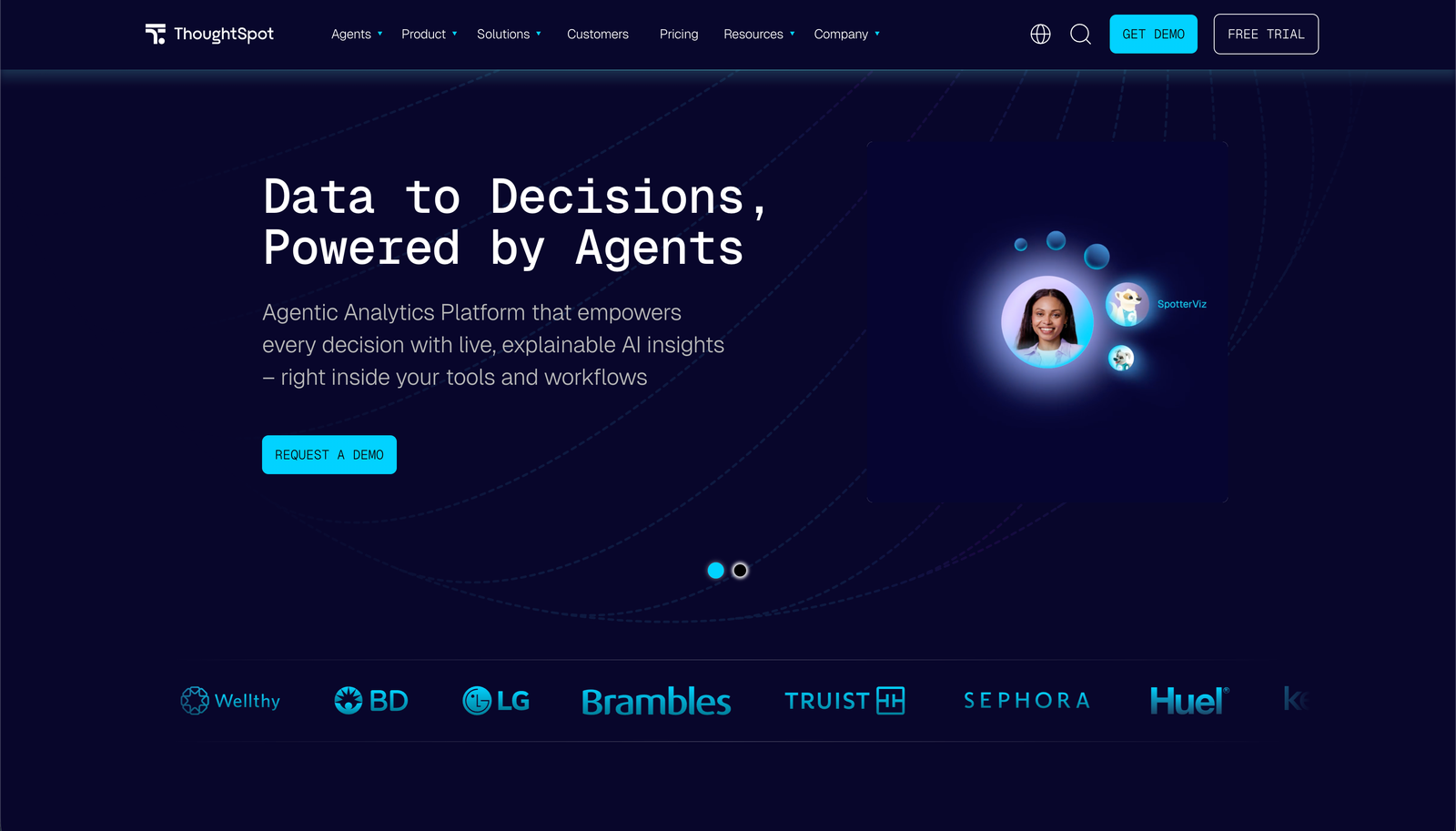
ThoughtSpot replaces dashboard building with search. Users type questions like "revenue by region last quarter" and get answers and charts back, with AI features that also surface trends and anomalies on their own.
- Natural language search that reduces dependency on SQL skills
- Works natively with cloud data warehouses
- SDKs for embedding search and charts in your own product
- Essentials plan from $25/user/month, billed annually; embedded analytics is priced separately
Watch outs
- Search-first workflows don't suit teams that rely on deeply customized dashboards
- Needs well-modeled data for search to return reliable answers
Best for
- Enterprises that want business users to ask their own questions
Other tools worth a look
- Domo combines data connectors, ETL, and dashboards in one cloud platform. Its credit-based pricing is quoted by sales.
- Holistics suits teams on dbt and Git, with SQL-based data models and reusable analytics logic. Plans start at $800/month billed yearly, with embedded analytics priced separately.
How to choose a Metabase alternative
There is no universal best BI tool. The right choice depends on your team's size, technical depth, and whether analytics stays internal or goes into your product.
By stage
- Early-stage startups: Draxlr is fast to set up, starts at $25/month, and includes AI querying. If you have engineers with time to self-host, Apache Superset and Redash are free.
- Growing teams: Draxlr covers both internal dashboards and customer-facing embeds. Sigma fits teams already on a cloud warehouse, and Power BI fits teams already on Microsoft.
- Enterprises: Tableau, Looker, Qlik, and ThoughtSpot bring the governance, semantic layers, and support contracts large organizations usually require.
Questions to answer before you shortlist
- Hosting: Do you need self-hosting for compliance, and do you have a developer to run upgrades and maintenance?
- Users: Will dashboards be built by analysts or explored by marketing, ops, and finance? Do non-SQL users need AI or natural language querying? See our guide to Metabase alternatives for non-technical teams.
- Data: Does the tool connect natively to every database you use, and do you need real-time data or is a daily refresh enough?
- Embedding: Will customers see dashboards inside your product? If so, check white-labeling, per-customer data security, and embed SDKs. Our list of Metabase alternatives for embedded analytics goes deeper.
- Governance: Do you need row-level security, audit logs, SSO, or SCIM?
- Pricing: What will the tool cost at twice your current user count, and are embedding, white-labeling, or SSO extra?
Pick your top two or three requirements, shortlist two tools, and run a pilot on your real data before committing.
FAQs
What is the best Metabase alternative in 2026?
It depends on your needs. Draxlr works well for AI assisted self-service and embedded analytics on SQL databases. Apache Superset and Redash are the leading open-source options. Tableau, Power BI, and Looker are strong enterprise choices, while Qlik and Sisense fit governed and embedded analytics use cases.
Is Metabase really free?
The open-source version is free to self-host, but someone has to set it up, maintain it, and handle upgrades. Metabase Cloud starts at $100/month for 5 users on Starter. Interactive embedding, row-level security, SSO, and white-labeling need the Pro plan at $575/month for 10 users.
What is the best open-source Metabase alternative?
Apache Superset is the most popular open-source alternative, with 40+ chart types, a SQL IDE, and row-level security. Redash is lighter and SQL-first. Both are free to self-host but need developer time to run. If you want a managed tool, Draxlr offers a 7-day free trial with no credit card required.
Which Metabase alternative is best for startups?
Draxlr is a strong pick for startups. It connects to your database in minutes, starts at $25/month, includes AI-generated SQL, and every plan includes unlimited customer viewers for embedded dashboards. Startups with engineering time and tight budgets can also self-host Apache Superset for free.
Which Metabase alternative is best for non-technical users?
Draxlr and Sigma are generally easier for non-technical users. Draxlr offers a visual query builder and an AI assistant that writes SQL from plain-English questions, while Sigma uses a familiar spreadsheet-style interface.
Which Metabase alternative is best for embedded analytics?
Draxlr and Sisense are commonly used for embedded analytics inside customer-facing applications. Draxlr embeds white-labeled dashboards with HTML, React, or Vue from the Premium plan, and adds row-level security and Full App Embedding on the Power plan.
Are there enterprise grade alternatives to Metabase?
Yes. Tableau, Power BI, Looker, Qlik, and Sisense are all enterprise grade BI platforms used at scale, with stronger governance, centralized semantic layers, and enterprise support contracts.
Is Metabase still a good BI tool in 2026?
Yes. Metabase remains useful for SQL friendly teams that want a quick, low-cost way to share dashboards internally. Many organizations move on when they need stronger AI support, easier access for non-technical users, or embedding without per-user costs.
About the author

Vivek is a coder and the founder of Draxlr who cares deeply about building good products. He works at the intersection of AI, SQL, dashboards, and embedded analytics, with a strong focus on making complex data workflows feel simple, useful, and fast for real teams.
If you have questions about anything in this guide, or want to compare options for your specific stack, you can email Vivek at vivek@draxlr.com, try Draxlr free, or reach out directly through the Draxlr team.