Natural Language to SQL: How It Works Under the Hood
How natural language to SQL works under the hood: input normalization, schema retrieval and linking, SQL generation, prompting, and execution validation.
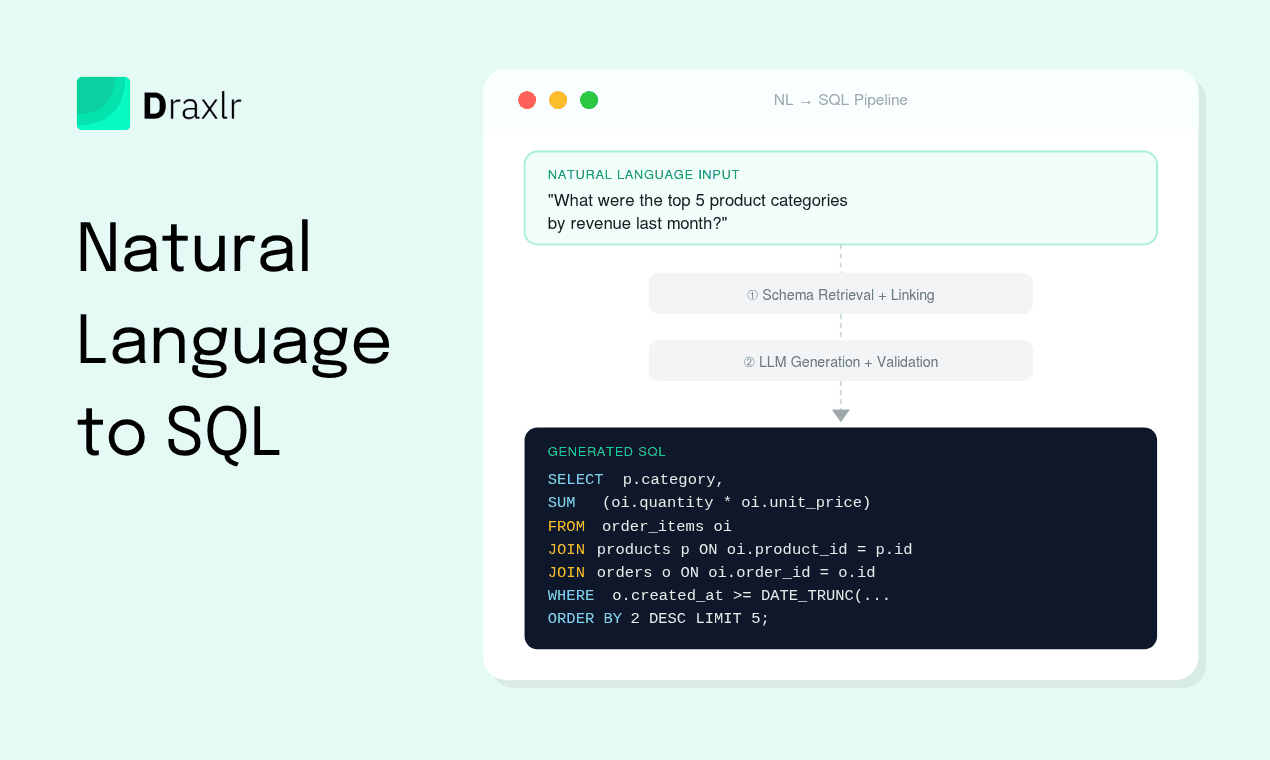
Natural language to SQL (NL2SQL) sounds deceptively simple on the surface: a user types a question, SQL comes out. But the gap between a sentence in plain English and a valid, semantically correct SQL query is enormous. Bridging it requires multiple stages of transformation — each with its own failure modes, design tradeoffs, and opportunities for improvement.
This article is a thorough technical breakdown of how modern NL2SQL pipelines work, from the moment a user submits a question to the moment a query executes against a real database.
The NL2SQL Pipeline: A Bird's-Eye View
Before diving into each component, here is the overall pipeline that a production-grade NL2SQL system runs through:
- Input normalization — clean and tokenize the user's natural language input
- Schema retrieval — fetch the relevant portion of the database schema
- Schema linking — map tokens in the user's question to concrete schema elements
- SQL generation — produce a candidate SQL query using an LLM or a structured decoder
- Post-processing and validation — parse the output, catch syntax errors, and verify executability
- Execution — run the query and return results
Each of these stages involves nontrivial decisions. A failure at any point silently propagates: a wrong schema link leads to a hallucinated column name, which produces a syntactically valid but semantically wrong query that returns results with no error — just incorrect data.
Stage 1: Input Normalization
Raw user input is messy. Before any semantic understanding can happen, the input needs to be normalized.
Tokenization
The user's question is split into tokens — words, subwords, or characters depending on the tokenization strategy. Modern LLMs (GPT-4, Claude, Llama) use byte-pair encoding (BPE) or SentencePiece, which handles out-of-vocabulary words by decomposing them into known subword units.
For example, "revenue" maps to a single token, but "MRR" might tokenize as ["M", "RR"] in a model that has never seen it. This matters because domain-specific terms like database column names (monthly_recurring_revenue) may be tokenized unpredictably, affecting attention patterns downstream.
Casing, punctuation, and spelling
Production systems typically apply:
- Lowercasing for matching against schema identifiers (which are often lowercase)
- Punctuation stripping for question marks, commas, and sentence-terminal tokens that carry no semantic load for SQL generation
- Spell correction using a domain-aware dictionary, since typos in entity names (
"revenu"instead of"revenue") will cause schema linking to fail silently
Query intent classification
Before schema linking, some systems run a lightweight classifier to detect the query intent: is this a SELECT, an aggregation, a time-series comparison, a filter-heavy lookup, or something the system cannot answer (e.g., a write operation or an ambiguous meta-question)? This gates the rest of the pipeline and avoids wasted LLM calls on unanswerable inputs.
Stage 2: Schema Retrieval
A real-world database can have hundreds of tables and thousands of columns. Passing the entire schema into an LLM's context window is:
- Expensive — schema DDL can easily consume 50–150k tokens for large databases
- Harmful to accuracy — LLMs suffer from "lost in the middle" degradation; relevant schema buried deep in a long context gets underweighted during attention
The solution is schema retrieval: given the user's question, select only the subset of tables and columns that are likely relevant.
Embedding-based retrieval
Table and column names (along with their descriptions and sample values, if available) are embedded into a vector space using a dense retrieval model. The user's question is also embedded, and cosine similarity is used to rank schema elements by relevance.
The typical retrieval model is a fine-tuned bi-encoder (e.g., text-embedding-3-large, or a fine-tuned BERT-class model) trained on (question, schema element) pairs from datasets like Spider, BIRD, or WikiSQL.
Top-K schema elements (commonly K=10–20 tables) are selected and passed to the next stage.
Hybrid retrieval
Pure embedding-based retrieval misses exact-match signals. A column named user_id should always be retrieved if the question mentions "user id", regardless of embedding proximity. Production systems layer BM25 keyword retrieval on top of embedding similarity, combining scores via reciprocal rank fusion (RRF):
final_score = α * embedding_score + β * bm25_score
Tuning α and β is an empirical process that varies by domain and schema vocabulary.
Schema graph traversal
Even after retrieval, join paths between retrieved tables must be resolved. A system that retrieves orders and customers must also know that these are joined on orders.customer_id = customers.id. This join metadata is stored in a schema graph (an in-memory directed graph where nodes are tables and edges are foreign key relationships) and is included in the LLM prompt alongside the selected tables.
Stage 3: Schema Linking
Schema linking is the process of grounding tokens in the user's question to specific schema elements. It is the single most important stage for output accuracy, and also the most error-prone.
Types of schema links
| Link type | Example | Maps to |
|---|---|---|
| Column mention | "revenue" | orders.total_amount |
| Table mention | "customers" | customers table |
| Value mention | "United States" | users.country = 'US' |
| Aggregation mention | "total", "average" | SUM(...), AVG(...) |
| Temporal mention | "last month" | WHERE created_at >= ... |
| Comparison mention | "more than 100" | > 100 |
Lexical matching
The simplest schema linking approach is string-matching: compare each token in the user question against the set of all table and column names. Exact matches are high-confidence links; fuzzy matches (Levenshtein distance ≤ 2) are flagged as candidates for LLM resolution.
Semantic matching
Lexical matching fails when the user's vocabulary doesn't align with schema naming. A user asking about "monthly recurring revenue" won't match a column named mrr. This requires embedding-based semantic matching against:
- Column names
- Column descriptions (if stored in schema metadata)
- Sample values (for value mentions like country names or status enums)
Value grounding
Value mentions are the hardest links to resolve. When a user asks "orders from Germany", "Germany" must be linked to the exact value stored in the country column — which might be "DE", "Germany", or "GERMANY" depending on how the data was loaded.
Robust systems index sample values for categorical columns (typically up to 10,000 distinct values per column) and run fuzzy matching at query time to resolve value mentions to their canonical stored form before injecting them into the SQL template.
Stage 4: SQL Generation
With the schema context assembled and schema links annotated, the actual query generation begins. There are three main approaches in active use.
Approach 1: Rule-based / template systems (legacy)
Early NL2SQL systems compiled user questions into SQL via hand-authored grammar rules and slot-filling templates. A question matching the pattern "top N <entity> by <metric>" would be mapped to:
SELECT <entity_col>, SUM(<metric_col>) AS total
FROM <entity_table>
GROUP BY <entity_col>
ORDER BY total DESC
LIMIT N;
These systems are fast and fully deterministic, but they break on questions outside the grammar and require significant manual maintenance as the schema evolves. They are mostly obsolete for production use.
Approach 2: Sequence-to-sequence neural models (fine-tuned)
Between 2018 and 2022, the dominant approach was fine-tuned encoder-decoder Transformers (T5, BART, CodeT5) trained on NL2SQL datasets. The input sequence is [question] [SEP] [schema DDL] and the output sequence is the SQL string.
These models achieved strong performance on controlled benchmarks (Spider: ~85% exact match with the best fine-tuned models) but suffered in production because:
- They are brittle to schema changes — a renamed column breaks the model
- They require expensive fine-tuning when new tables or domains are added
- They do not generalize to multi-hop questions with complex subqueries
Approach 3: LLM-based generation with structured prompting (current state of the art)
Modern production NL2SQL systems use large language models (GPT-4, Claude 3.5, Gemini 1.5 Pro, or open-source equivalents like Llama 3 70B fine-tuned on SQL) with a carefully engineered prompt. The LLM is not fine-tuned on domain-specific data; instead, all domain knowledge is injected at inference time through the prompt.
A typical prompt structure looks like:
You are an expert SQL writer. Given the database schema and a user question,
write a syntactically correct SQL query.

DATABASE DIALECT: PostgreSQL 15

SCHEMA:
Table: orders (id INT PK, customer_id INT FK→customers.id, total_amount DECIMAL,
               status VARCHAR, created_at TIMESTAMP)
Table: customers (id INT PK, name VARCHAR, country VARCHAR, email VARCHAR)
Table: products (id INT PK, name VARCHAR, category VARCHAR, price DECIMAL)
Table: order_items (id INT PK, order_id INT FK→orders.id, product_id INT FK→products.id,
                    quantity INT, unit_price DECIMAL)

FOREIGN KEYS:
- orders.customer_id → customers.id
- order_items.order_id → orders.id
- order_items.product_id → products.id

USER QUESTION: "What were the top 5 product categories by revenue last month?"

RULES:
- Only use tables and columns from the schema above
- Do not use column names that do not exist in the schema
- For date filtering, today is 2026-04-24
- Return only the SQL query, no explanation

SQL:
The LLM completes the prompt by generating the SQL. This approach is powerful because:
- It leverages the LLM's deep understanding of SQL syntax, functions, and idiomatic patterns
- Schema context is injected fresh at every call, so schema changes don't require model retraining
- Few-shot examples in the prompt can steer the model toward dialect-specific syntax (PostgreSQL window functions, BigQuery ARRAY functions, etc.)
Stage 4a: Prompt Engineering Depth
The quality of the generated SQL is almost entirely determined by the quality of the prompt. Several techniques significantly improve output accuracy.
Few-shot examples
Including 3–5 (question, SQL) examples directly in the prompt — selected to be semantically similar to the current question — dramatically improves output quality. This is called in-context learning and is more sample-efficient than fine-tuning for most production databases.
Example selection is typically done by embedding similarity: the system finds the K most similar questions from a curated example bank and inserts them into the prompt.
Chain-of-thought (CoT) prompting
For complex queries (multi-table joins, nested subqueries, window functions), adding a scratchpad step before the final SQL output improves accuracy. The model is instructed to:
- Identify which tables are needed
- Identify which columns are needed
- Determine the join conditions
- Determine the aggregation logic
- Write the final SQL
This mirrors how a skilled analyst would approach the problem and significantly reduces errors on queries that require multi-step reasoning.
Dialect-specific instructions
SQL syntax varies significantly across databases. DATE_TRUNC exists in PostgreSQL and BigQuery but not MySQL. TOP N is SQL Server syntax; LIMIT N is MySQL/PostgreSQL. Window functions are available in PostgreSQL 8.4+ but have limited support in some older MySQL versions. The prompt must explicitly specify the database dialect and version, and optionally include dialect-specific function examples.
Self-consistency sampling
For high-stakes queries, the system generates N independent SQL candidates (N=5–10) with temperature > 0, then selects the most common output via majority voting or executes all and selects the one that returns the most plausible result. This is computationally expensive but dramatically reduces one-off hallucination errors.
Stage 5: Post-Processing and Validation
The LLM output cannot be trusted blindly. Before execution, the generated SQL must pass a validation layer.
Syntax parsing
The SQL string is parsed using a database-specific parser (e.g., sqlglot, pglast, sqlparse) to verify syntactic correctness. If parsing fails, the error message is fed back to the LLM as a second-pass correction prompt:
The following SQL has a syntax error: [error message]

Original query: [query]

Corrected query:
This self-repair loop resolves the majority of LLM syntax errors, which are usually minor (missing commas, unclosed parentheses, wrong function name casing).
Schema validation
After parsing, the AST (abstract syntax tree) of the query is traversed to verify:
- Every referenced table exists in the schema
- Every referenced column exists in the referenced table
- Every function call is valid for the target database dialect
References that fail validation are flagged for correction. This catches the most common hallucination: the LLM inventing a column name that sounds plausible but doesn't exist.
Semantic validation
Some semantic errors can be caught statically:
- Aggregation without GROUP BY:
SELECT customer_id, SUM(amount) FROM orders—customer_idis ungrouped in an aggregate query - Ambiguous column references:
SELECT name FROM orders JOIN customers ON ...—nameexists incustomersbut notorders; some dialects will error, others will silently return wrong data - Cross-dialect functions: calling a PostgreSQL function against a MySQL connection
Dry-run execution (EXPLAIN / LIMIT 0)
For SQL that passes syntactic and semantic validation, a final check runs the query with EXPLAIN (or LIMIT 0 for SELECT) to verify the query planner can resolve it. This catches runtime errors like:
- Type mismatches (
WHERE created_at > 'not a date') - Schema drift (a column was dropped after the schema cache was last updated)
- Permission errors (the query user lacks SELECT on a referenced table)
Stage 6: Execution and Result Handling
The validated query is executed against the database through a connection pool. Result handling includes:
Result set sizing
Unbounded queries (SELECT * FROM orders) can return millions of rows. The execution layer always wraps user queries with a LIMIT clause (typically 1000–10000) unless the user's intent requires a full aggregation. For aggregation queries, row counts are naturally bounded by the number of distinct group values.
Automatic visualization suggestion
The result set schema (column names, data types, cardinality) is analyzed to suggest the appropriate visualization:
| Result shape | Suggested chart |
|---|---|
| 1 column, 1 row | KPI / metric card |
| 1 numeric column, N rows | Bar chart |
| 1 date column + 1 numeric column | Line chart |
| 2 columns (category + numeric) | Bar or pie chart |
| Many columns, many rows | Data table |
| 2 numeric columns | Scatter plot |
This analysis is deterministic and based on column type inspection — it does not require another LLM call.
Error surfacing
If the query fails at execution time despite passing all validation stages, the raw database error is translated into a user-friendly message and fed back into the correction loop. Production systems keep a retry budget (typically 2–3 attempts) before surfacing a failure to the user with an explanation of what went wrong.
Key Challenges and Failure Modes
Understanding where NL2SQL systems fail is as important as understanding how they work.
Ambiguity
Natural language is inherently ambiguous. "Show me the top customers" could mean:
- Top customers by total spend
- Top customers by order count
- Top customers by recency
- Top customers in a specific region
Without disambiguation, the system must make a default interpretation. Production systems handle this by either asking a clarifying question (at the cost of user experience latency) or generating the most statistically common interpretation and surfacing it transparently to the user.
Multi-hop reasoning
Questions that require chaining multiple logical steps — "Which customers placed orders this quarter but not last quarter?" — require the model to generate subqueries or CTEs. LLMs with strong code understanding handle this well, but smaller or less capable models often flatten these into incorrect single-level queries.
Temporal reasoning
Temporal expressions like "last month", "this quarter", "year to date", "rolling 30 days" must be resolved to concrete date boundaries at query time. This requires injecting the current timestamp into the prompt and ensuring the model can correctly compute:
DATE_TRUNC('month', CURRENT_DATE) - INTERVAL '1 month'for "last month start"DATE_TRUNC('month', CURRENT_DATE) - INTERVAL '1 day'for "last month end"
Errors here are silent: the query runs and returns results, but for the wrong date range.
Schema sparsity
When a database schema has minimal metadata — no column descriptions, no sample values, ambiguous naming conventions (col_a, val1, flag_x) — schema linking fails and the LLM hallucinates. The quality of NL2SQL output is fundamentally bounded by the quality of schema documentation.
Dialect fragmentation
Deploying one NL2SQL system across PostgreSQL, MySQL, BigQuery, Redshift, Snowflake, and SQL Server requires handling significant SQL dialect differences. A single prompt template cannot cover all dialects. Production systems maintain per-dialect prompt templates and use the schema retrieval stage to inject dialect-appropriate function examples.
Accuracy Benchmarks
The standard NL2SQL benchmark is Spider (Yale, 2018) — 10,181 questions across 200 databases. Current state-of-the-art systems achieve:
| System | Spider exact match |
|---|---|
| RESDSQL (2022, fine-tuned T5) | 79.9% |
| DIN-SQL + GPT-4 (2023) | 82.8% |
| DAIL-SQL + GPT-4 (2023) | 86.6% |
| MCS-SQL + GPT-4 (2024) | 89.6% |
| Claude 3.5 Sonnet (few-shot) | ~87–89% |
The BIRD benchmark (2023) is considered harder and more realistic — it includes value linking, external knowledge requirements, and noisier schemas. Top systems score ~65–72% on BIRD, exposing a significant gap between benchmark performance and real-world deployment quality.
Production accuracy on real enterprise databases is typically lower than benchmark numbers due to schema complexity, domain-specific terminology, and the long tail of unusual question patterns.
Architecture Summary
A production NL2SQL system looks like this end-to-end:
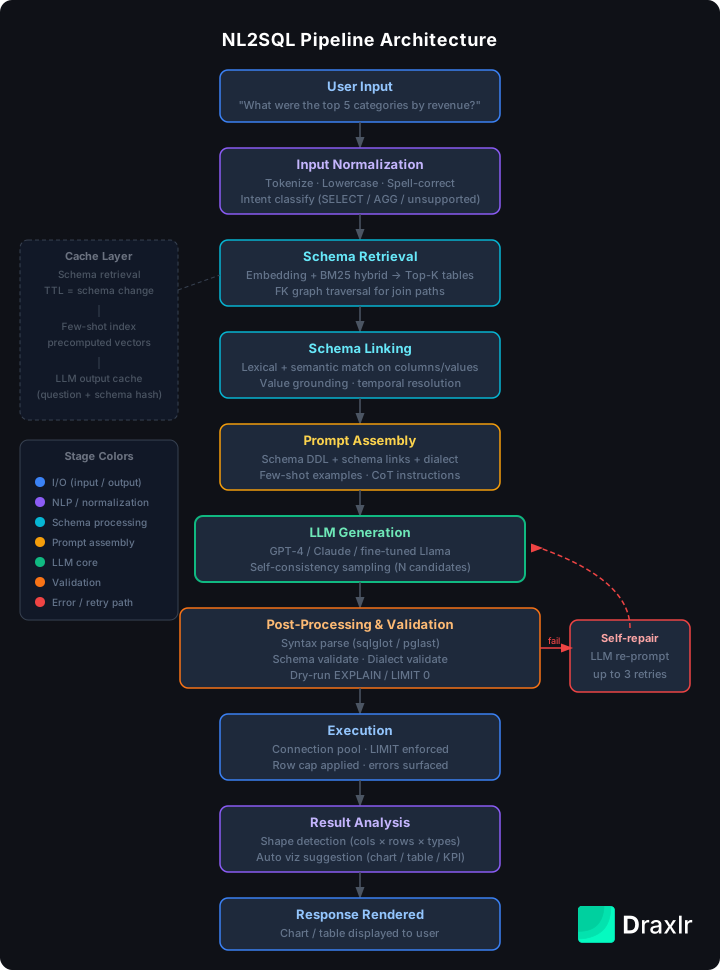
Every stage is independently cacheable. Schema retrieval results can be cached per-database with a TTL tied to schema change events. Few-shot examples can be precomputed and stored in a vector index. LLM outputs can be cached for identical (question + schema hash) inputs, eliminating redundant inference costs for repeated questions.
What Makes a Good NL2SQL System
The gap between a toy demo and a production-ready NL2SQL system comes down to a few properties:
Schema grounding. The system must work against your actual schema, not a generic one. Every table, every column, every foreign key must be available to the model at inference time with accurate metadata.
Validation depth. SQL that parses correctly can still be semantically wrong. A robust validation layer that catches schema violations, aggregation errors, and type mismatches before execution is non-negotiable.
Dialect fidelity. A system that only works on one database type is limited. Production NL2SQL must handle the dialect your database actually speaks.
Failure transparency. When the system cannot answer a question confidently, it should say so rather than returning plausibly wrong results. Silent failures are the most dangerous outcome in a data analytics context.
Self-improvement loop. Each query that fails or gets corrected by a user is a labeled training example. Systems that capture this signal and use it to improve few-shot examples or fine-tune retrieval models improve continuously over time.
NL2SQL has moved far beyond research benchmarks. The underlying technology is mature enough for production use at scale, and the systems that deploy it well are the ones that treat it as an engineering discipline — with attention to schema quality, validation rigor, and feedback loops — rather than a one-shot LLM call.
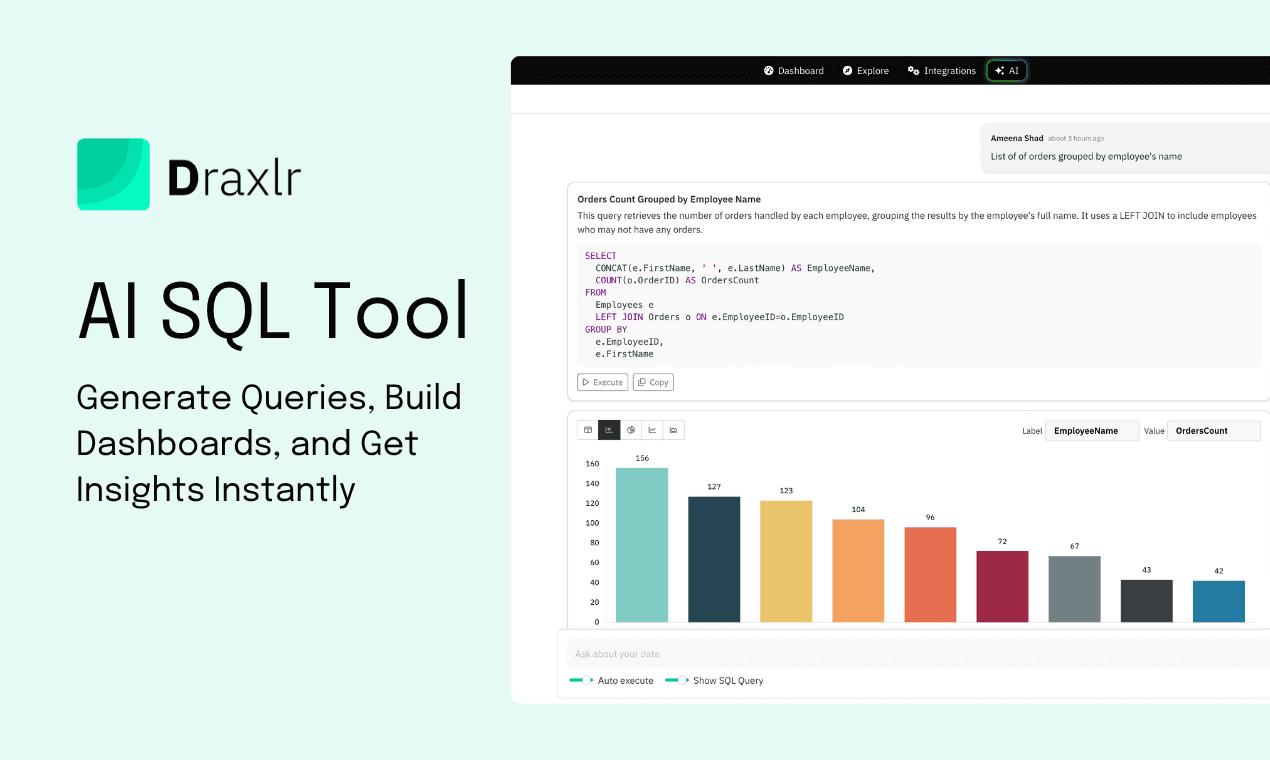
If you want to see these principles in action without building the pipeline yourself, Draxlr's AI SQL tool implements schema-grounded NL2SQL end-to-end — letting your team query any connected database in plain English and get back charts and dashboards instantly.
About the author

Vivek is a coder and the founder of Draxlr who cares deeply about building good products. He works at the intersection of AI, SQL, dashboards, and embedded analytics, with a strong focus on making complex data workflows feel simple, useful, and fast for real teams.
If you have questions about anything in this guide, or want to compare options for your specific stack, you can email Vivek at vivek@draxlr.com, try Draxlr free, or reach out directly through the Draxlr team.