Metabase Alternatives for Non-Technical Teams in 2026
Compare the best Metabase alternatives for non-technical teams in 2026. AI querying, no-code dashboards, and embedded analytics to find the right fit for your team.
Metabase is one of the most popular open source BI tools out there, and for good reason. It's powerful, flexible, and free to get started. But that "free" comes with hidden costs. You'll still need to handle deployment, server management, ongoing maintenance, and infrastructure expenses, which can add up quickly for teams without dedicated engineering resources. And even setting those costs aside, it's not the only option. Depending on your team's size, technical setup, and budget, another tool might be a better fit.
This guide covers the best Metabase alternatives for non-technical teams, with a focus on ease of use, flexible querying, and self-service reporting.
Why Teams Look for Metabase Alternatives
Before we get into Metabase alternatives, it's worth understanding specifically where Metabase falls short for teams because the friction points are specific, not general.
Metabase does have AI. Its Metabot feature allows users to generate SQL from natural language, fix query errors, and summarize chart results. That's genuinely useful but with important caveats:
- Metabot costs extra. It's a paid add-on at $100/month for 500 queries, on top of your existing plan. It's not part of the default experience.
- Metabot is Cloud-only. If your team uses the free self-hosted version, you don't get AI at all.
- The underlying interface is still query-centric. Even with Metabot, users land in an environment built around data exploration. Non-technical users don't know what question to ask — they need the tool to guide them.
- Metabot is limited in scope. It handles basic single-level aggregations, but complex cross-table analysis still requires SQL knowledge.
- Self-hosting has real overhead. Setting up and maintaining Metabase on your own infrastructure requires engineering time most small teams don't have.
None of this makes Metabase a bad tool. For technical teams that want a free, flexible BI platform, it's excellent. But for non-technical teams who need data to be truly self-serve, the alternatives below offer a fundamentally better experience.
What to Look for in a Metabase Alternative for Non-Technical Teams
- AI built into the core experience. Not a paid add-on or a Cloud-only feature
- Natural language querying. Ask questions in plain English and get reliable answers without SQL
- No-code dashboard creation. Build, share, and update without writing a query
- Minimal setup. Cloud-hosted options with fast time-to-value, no DevOps required
Quick Comparison: Metabase Alternatives for Non-Technical Teams in 2026
| Tool | Natural Language Queries | Starting Price | Best For |
|---|---|---|---|
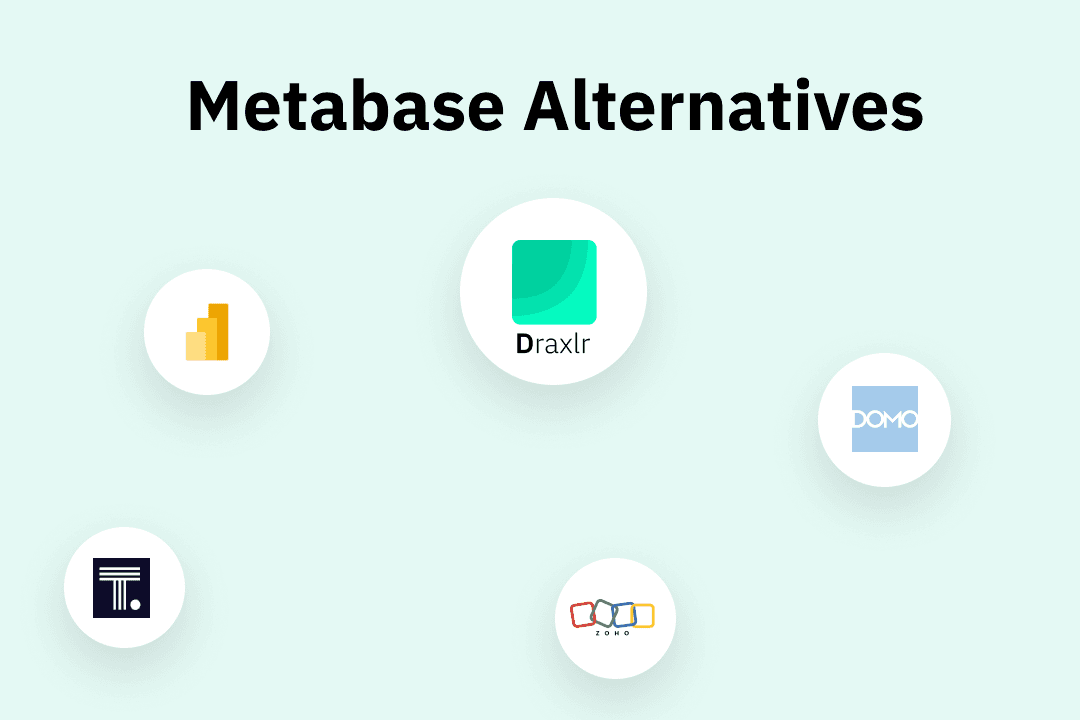
| Draxlr | Yes | $25/month | AI-powered analytics for non-technical teams |
| Microsoft Power BI | Yes | $24/user/month | Teams in the Microsoft ecosystem |
| Domo | Yes | Custom | All-in-one platform for large teams |
| ThoughtSpot | Yes | $50/user/month | Enterprise data democratization |
| Zoho Analytics | Yes | $30/month | Teams in the Zoho ecosystem |
1. Draxlr
Best Metabase Alternatives for AI-Powered Analytics for Non-Technical Teams
Best for: Startups, SaaS teams, and growing businesses that want fast, self-service analytics without engineering overhead.
Draxlr is an AI-powered analytics platform built for non-technical teams. Its AI assistant lets anyone on your team ask questions in plain English and get back a visualization with a plain English summary. No SQL, no query builder, no engineering support needed.
Key Features
AI-first querying. Type a question like "Show me revenue by region last quarter" and Draxlr generates the SQL, runs it, renders a chart, and explains the result in plain English, all automatically. Non-technical users get answers immediately without needing to understand the underlying data model.
Embeddable Dashboards. Product and SaaS teams can embed white-label dashboards directly into their customer-facing applications, complete with row-level filtering and multi-tenant support.
Automated Alerts. Set threshold-based alerts on your key metrics and receive notifications via Slack or email when data changes, keeping your team informed without anyone logging in to check.
Broad Database Support. Connects to PostgreSQL, MySQL, BigQuery, Snowflake, Redshift, Supabase, ClickHouse, Databricks, and more, covering most modern data stacks without additional configuration.
Saved Queries and Dashboards. Build and save queries as reusable reports, then organize them into dashboards that your whole team can access and explore. No rebuilding the same report from scratch every week.
Role-based Access Control. Control who can view, edit, or share data within your workspace. Useful for teams that need to manage access across departments or clients.
Self-hosting Option. For teams with data residency or compliance requirements, Draxlr supports self-hosted deployment alongside its cloud offering.
Who It's For
Draxlr is particularly well-suited for marketing, sales, and operations teams that need to self-serve their reporting without pulling in engineers. It's also a strong choice for SaaS founders who want to offer analytics inside their product without building a custom reporting layer.
Pricing
Draxlr starts at $25/month with a free trial available. Plans scale based on database, team size and features.
Draxlr vs. Metabase
| Feature | Draxlr | Metabase |
|---|---|---|
| Natural language (AI) queries | ✅ Included by default | ❌ Paid add-on only |
| Setup complexity | ✅ Low (cloud-hosted) | ❌ Medium-High (self-hosted) |
| White-label embedded dashboards | ✅ All plans | ❌ Paid plans only |
| Automated Slack / email alerts | ✅ Built-in | ❌ Limited |
| Visual Query Builder | ✅ | ✅ |
2. Microsoft Power BI
Best Metabase Alternatives for Teams in the Microsoft Ecosystem
Best for: Companies already using Microsoft 365, Azure, or SQL Server who want BI that integrates natively with their existing stack.
Power BI is Microsoft's flagship analytics tool, and for teams already in the Microsoft orbit, it offers deep native integration with Excel, Teams, Azure Synapse, and Dynamics 365 that no competitor can match.
Key Features
- Native Microsoft integrations, Excel files become data sources in seconds
- AI-powered Q&A, for natural language querying (improving rapidly)
- Power BI Embedded, for embedding dashboards in applications
- Scheduled reports and automated alerts
Who It's For
Power BI is the natural choice for any organization deeply embedded in Microsoft infrastructure. If your data lives in Azure SQL, SharePoint, or Excel, Power BI will feel like a natural extension of your existing workflow.
Pricing
Power BI Desktop is free to download. Advanced AI features like Copilot require the Premium Per User plan at $24/user/month.
3. Domo
Best Metabase Alternatives for Large Teams Needing an All-in-One Platform
Best for: Enterprise and mid-market teams that want to consolidate data, dashboards, and collaboration in a single platform.
Domo is a cloud-native business intelligence platform that combines data integration, visualization, and collaboration tools under one roof. With over 1,000 data connectors, it's designed to connect every source of business data and make it accessible across the entire organization.
Key Features
- 1,000+ data source connectors, including Salesforce, Google, AWS, Snowflake, and Redshift
- AI and machine learning tools for predictive analytics and automated insights
- 150+ chart types for rich, customized data storytelling
- App building capabilities to create custom business applications on top of your data
- Mobile-first design with a polished iOS and Android experience
Who It's For
Domo works best for organizations that need a centralized data platform across multiple departments, with strong governance, real-time data access, and executive-level dashboards.
Pricing
Available on request.
4. ThoughtSpot
Best Metabase Alternatives for Enterprise Search-First Analytics
Best for: Mid-size and enterprise teams that want a Google-like search experience for their data, without writing SQL.
ThoughtSpot pioneered the "search-first" approach to analytics — you type a question like you'd search on Google, and the platform instantly generates the most relevant chart or table. It's one of the most genuinely non-technical analytics experiences available.
Key Features
- Spotter. Conversational AI agent for natural language data exploration
- SpotIQ. Automated analytics that proactively surfaces hidden insights you didn't know to ask for
- SpotterViz. Build dashboards using natural language descriptions, no manual configuration needed
- SpotterModel. Create semantic models without writing code
- Enterprise-scale performance. Designed to handle billions of rows across large, complex data environments
- Strong governance and security. Role-based access, audit logs, and fine-grained permissions built in
Who It's For
ThoughtSpot is best suited for mid-size and enterprise teams who want to democratize data access across the entire organization. It's a strong fit for data-forward companies that need self-service analytics at scale, without requiring every user to understand SQL or data modeling.
Pricing
Starts at $50/user/month
5. Zoho Analytics
Best Metabase Alternatives for Teams in the Zoho Ecosystem
Best for: SMBs and mid-market companies already using Zoho CRM, Zoho Books, or other Zoho apps.
Zoho Analytics is a full-featured BI platform with strong AI capabilities built in. Its "Zia" AI assistant allows users to ask questions conversationally and receive charts and summaries in response — making it one of the most mature natural language analytics experiences outside of enterprise tools.
Key Features
- 500+ data source integrations, including popular CRMs, databases, cloud storage, and spreadsheets
- Zia AI assistant for natural language queries and auto-generated insights
- Drag-and-drop report builder requiring no technical expertise
- Automated reporting with scheduled delivery via email
- Role-based access control to manage who can see or edit data
Who It's For
Zoho Analytics works best for companies already invested in the Zoho ecosystem, where native integrations eliminate much of the data wiring effort. For standalone use, it's still a capable option, though the interface can feel dense for first-time BI users.
Pricing
Plans start at $30/month for 2 users and scale up.
How to Choose the Right Metabase Alternative
With so many solid options, the right choice depends on a few key questions:
Do you have any technical resources available for setup? If the answer is no, prioritize cloud-hosted tools like Draxlr or Zoho Analytics that require minimal configuration.
Where does your data live? If it's in Microsoft products, Power BI wins on integrations and cost. If it's in a SQL database, Draxlr's direct database connectivity is a significant advantage.
Do you need AI-powered querying? Metabase's Metabot costs an extra $100/month on top of the Starter plan for just 500 requests. Both Draxlr and ThoughtSpot offer strong natural language querying, but ThoughtSpot is geared toward enterprise teams while Draxlr is more accessible for smaller teams on a budget.
What's your budget? Draxlr and Zoho Analytics offer affordable entry points. Power BI is cost-effective for Microsoft shops. Domo sits at the enterprise end of the spectrum.
Will you need customer-facing dashboards? For embedded analytics in your own product, Draxlr's white-label embedding and multi-tenant support make it the most purpose-built option on this list.
Which Metabase Alternative Is Right for Your Team?
- Working with SQL databases and want AI included from day one → Draxlr
- Need enterprise-grade natural language search at scale → ThoughtSpot
- Want one platform handling your entire data stack → Domo
- Already in the Microsoft ecosystem and want native integrations → Power BI
- Need an all-in-one BI tool with strong data source coverage → Zoho Analytics
Conclusion
The best Metabase alternatives for non-technical teams aren't just "easier" versions of the same thing. They represent a different philosophy. Data tools should adapt to how business users think and work, not the other way around.
The difference that matters most isn't which tool has AI. Most do. What matters is whether AI is central to how non-technical users interact with data from the moment they open the product, or whether it's an add-on layer sitting on top of an interface that still assumes technical knowledge.
For teams where data access should be truly self-serve, that distinction is everything. Most tools on this list offer a free trial or demo. Pick the one that matches your biggest friction point and start there.
FAQs
1. What is the best free alternative to Metabase?
Metabase itself has a free open-source version, but it requires self-hosting and technical setup. Among the paid alternatives on this list, Draxlr, Zoho Analytics and Power BI offer the most affordable entry points with free trials, making them worth evaluating before committing.
2. Is Metabase good for non-technical teams?
Metabase has a visual query builder that works well for basic questions, but more complex queries still require SQL. Its AI querying feature, Metabot, is available as an add-on at $100/month for 500 requests on top of the Starter plan which can be a barrier for teams that need it regularly. Tools like Draxlr include AI querying as part of their core offering.
3. What is the easiest BI tool for non-technical users?
It depends on your use case. For teams that want multiple ways to query data — AI, visual builder, or raw SQL — Draxlr is one of the most flexible options. For teams already in the Microsoft ecosystem, Power BI's familiar interface lowers the learning curve significantly. Zoho Analytics is also a strong contender for SMBs that want a guided, all-in-one experience.
4. Which Metabase alternative is best for embedded analytics?
Draxlr is the most purpose-built option for embedded, customer-facing dashboards on this list — offering white-label embedding and multi-tenant support without enterprise pricing. Domo and ThoughtSpot also support embedding but are geared toward larger organizations with bigger budgets.
5. Which Metabase alternative is best for non-technical teams?
Draxlr is the strongest option for non-technical teams. It lets users query data in plain English, use a visual query builder, all without needing a developer involved. Zoho Analytics is also a solid pick for teams that want a guided, all-in-one experience with minimal setup. Both include AI querying as a core feature, unlike Metabase where it comes as a paid add-on.